The “Cycle & Soak” Method: Beating Central Coast Clay Runoff
The Diagnostic:
You run your sprinklers long enough to “do it right”… and five minutes later you’re watching your expensive water sprint down the sidewalk like it’s late for a meeting. The lawn still looks thirsty, the shrub bed is half-wet, and the gutter is getting the best irrigation on the property.
On the Central Coast, this is classic: heavy clay, mild slopes, compacted soils, and sprinkler output that applies water faster than the ground can absorb it.
The Science:
Most irrigation systems don’t fail because they “don’t run long enough.” They fail because they run too long in one continuous stretch.
Clay soils absorb water slowly. When water hits clay faster than it can infiltrate, it ponds, seals the surface, and becomes runoff. That runoff is wasted water—and it can carry soil, fertilizer, and other pollutants into storm drains.
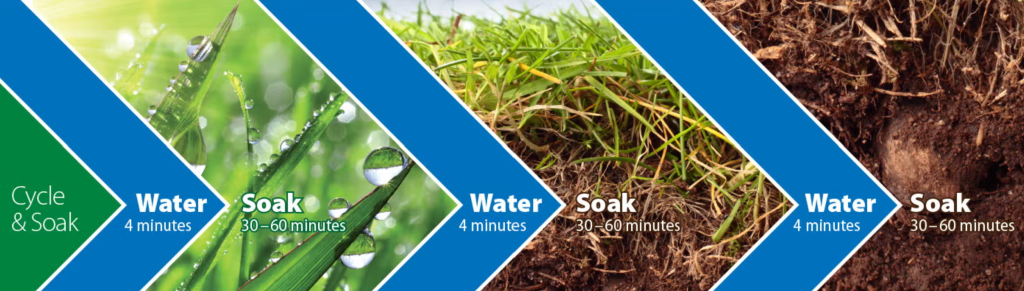
Cycle & Soak fixes this by breaking one long watering into short watering cycles with rest periods in between, so water has time to move down into the root zone instead of sideways into the street. This is exactly what WaterSense describes: short intervals + breaks = less runoff, more water stored in the soil where plants can use it.
Think of it like this:
- Cycle = “Apply water just until runoff almost starts.”
- Soak = “Pause long enough for the soil to accept what you already gave it.”
- Repeat until you reach the total watering you actually need.
Bonus: many smart/controllers use soil type + slope to help calculate max runtimes to avoid runoff (cycle/soak logic).
The Red Flags:
If you see these, you’re a perfect candidate for Cycle & Soak:
- Runoff within 3–8 minutes of turning on sprays or rotors (water reaches sidewalk/gutter).
- Puddling at low spots, around heads, or near compacted walkways.
- Uneven color: green stripes + dry patches (often runoff + poor distribution).
- Mushroom/moss/algae zones (too much water sitting on the surface, not soaking in).
- “I water a lot but it still looks stressed”—common when most water never reaches roots.
- Hard, sealed soil that repels water (compaction or poor structure).
- Mulch volcanoes or wet trunks (watering patterns hitting the wrong places—especially bad for trees).
Reference: U.S. Environmental Protection Agency (WaterSense). Cycle-and-Soak Brochure.
The ArborSolutions Guide’s Action:
Here’s how to set Cycle & Soak the field-tested way (no engineering degree required).
Step 1: Find your “runoff time” (the single most useful number)
Pick one zone (start with the worst offender).
- Turn the zone on.
- Watch carefully.
- Start a timer and note when you see:
- water flowing off the area, or
- puddles forming and starting to connect, or
- water sheening across the surface toward the pavement
- water flowing off the area, or
That timestamp is your Runoff Time.
Rule of thumb: set your Cycle Time to about 60–80% of Runoff Time.
- If runoff starts at 6 minutes, start with 4 minutes per cycle.
- If runoff starts at 10 minutes, start with 7–8 minutes per cycle.
This aligns with the WaterSense guidance: break irrigation into smaller intervals with breaks so clay/slope sites can absorb water before it runs off.
Step 2: Choose a soak time that matches clay reality
For Central Coast clay, soak time commonly needs to be 30–60 minutes (sometimes longer on compacted slopes). Heavy soils often benefit from longer soak intervals for best retention.
Starter settings:
- Clay + flat-ish yard: 30–45 min soak
- Clay + slope / runoff-prone: 45–60+ min soak
Step 3: Decide how many cycles you need (based on sprinkler type)
You’re not necessarily watering more—you’re watering smarter.
Typical starting points:
- Spray heads (higher output): 3–5 cycles
- Rotors (lower output): 2–4 cycles
- Drip (yes, even drip sometimes): 1–3 cycles if it’s pooling or running off on slopes/compacted beds
Step 4: Build a simple starter schedule (examples you can copy)
These are starter templates—you’ll adjust based on plant type, sun exposure, and season.
Example A: Spray zone on clay (runoff at 6 minutes)
- Cycle: 4 minutes
- Soak: 45 minutes
- Cycles: 4
- Total water time: 16 minutes (spread out)
Example B: Rotor zone on clay (runoff at 12 minutes)
- Cycle: 8–9 minutes
- Soak: 45–60 minutes
- Cycles: 3
- Total water time: 24–27 minutes (spread out)
Example C: Shrub bed on slope with drip (pooling near emitters)
- Cycle: 10–15 minutes
- Soak: 30–60 minutes
- Cycles: 2–3
- Total water time: 20–45 minutes (spread out)
Step 5: Use your controller’s built-in tools (or the “multiple start times” workaround)
Many controllers and smart apps literally have a Cycle & Soak feature—especially helpful for clay and slopes.
If yours doesn’t, use:
- Multiple start times in the same watering day (manual Cycle & Soak).
Step 6: Fix the “hidden causes” that make runoff worse
Cycle & Soak is powerful—but don’t ignore the basics:
- Level and align sprinkler heads (tilted heads = instant runoff in one direction).
- Head-to-head coverage (dry spots often cause people to overwater, which increases runoff).
- Reduce overspray onto pavement (wasted water = guaranteed runoff).
- Mulch correctly (3–4 inches in beds, kept away from trunks) to slow evaporation and improve soil moisture behavior.
- Don’t fertilize your way into runoff (lush, soft growth increases demand and tempts longer run times).
Step 7: Confirm you’re actually watering roots, not just “making it wet”
After you run Cycle & Soak for a week, do a quick check:
- Use a screwdriver or soil probe 6–8″ down (deeper for established shrubs/trees).
- The goal is moist below the surface, not swampy on top.
UC guidance also highlights that clay soils take longer to wet deeply and tend to spread water more horizontally—so the soak breaks matter.
References (Footnotes)
- U.S. EPA WaterSense. Cycle-and-Soak Brochure (PDF).
- U.S. EPA WaterSense. “Sprinkler Spruce-Up” (cycle-and-soak definition and purpose).
- UC Davis / California Agriculture & Natural Resources (Linda Chalker-Scott / Leah Oki via CAES). “Conserve water with landscape irrigation strategies” (runoff + cycle and soak setting).
- UC ANR. Water-wise gardening guidance (cycling/soaking on clay or slopes; mulch guidance).
- UC ANR (L. Oki). “Keeping Plants Alive under Drought or Water Restrictions” (clay wetting behavior).
Need a Professional 2nd Opinion?
The information above is a general guide, but every landscape is a complex, living system—and irrigation is where small mistakes quietly become expensive ones.
At ArborSolutions, we do not sell tree work or landscaping services. We provide unbiased data and professional advice so you can make confident decisions without guesswork.
Ready to dial in your irrigation and protect your landscape investment?
Book a Walking-Talking Tour for a site-specific diagnostic and a clear, science-based path forward.
Schedule Your Tour at ArborSolutions.pro
Educational use only. For site-specific irrigation advice (especially around mature trees, slopes, drainage issues, or chronic runoff), consult a qualified professional.