
Soil Lab Testing: Why “Guessing” is Expensive
I frequently encounter property owners on the Central Coast who have spent thousands of dollars on “soil health” products—gypsum, sulfur, specialized fertilizers, and bio-stimulants—without ever seeing a measurable improvement in their trees. In the world of high-value arboriculture, applying amendments without data is essentially “prescribing medication without a blood test.”¹
As an independent consultant, I view a Soil Laboratory Analysis as the most cost-effective insurance policy you can buy for your landscape. Whether you are managing a historic Oak in Montecito or a new orchard in Paso Robles, knowing exactly what is happening in the root zone is the only way to stop wasting money on the wrong solutions.
1. The Hidden Economics of Guessing
The “Home Depot approach” to soil management is often to buy what’s on sale or what a neighbor recommends. However, Central Coast soils are notoriously variable, even within a single neighborhood.
- The Over-Correction Trap: I often see property owners adding lime to “sweeten” their soil, only to find out their pH was already alkaline. This further locks up micronutrients and can take years of expensive sulfur applications to reverse.²
- The Luxury Consumption Waste: Trees will often absorb more of a specific nutrient than they need if it is over-applied (like Potassium). This doesn’t make the tree “healthier”; it just wastes your money and can actually interfere with the uptake of other critical minerals like Magnesium.
2. What a Professional Lab Test Actually Reveals
A standard “box store” test kit typically only looks at Nitrogen (N), Phosphorus (P), and Potassium (K). For a tree, this is barely the surface. A professional lab report provides the data that actually dictates tree health:
- Cation Exchange Capacity (CEC): This measures the soil’s “fuel tank” capacity—its ability to hold and release nutrients. Sandy soils in Nipomo have low CEC, while Santa Barbara clays have high CEC. Knowing this tells us how often you actually need to fertilize.³
- Base Saturation: This shows the balance of Calcium, Magnesium, and Potassium. If these are out of sync, the tree’s “osmotic pump” fails, leading to stress even if the soil is wet.
- Sodium Adsorption Ratio (SAR): Critical for coastal zones, this tells us if the salt in your soil is at toxic levels that require immediate leaching.⁴
3. Sampling: The “Garbage In, Garbage Out” Rule
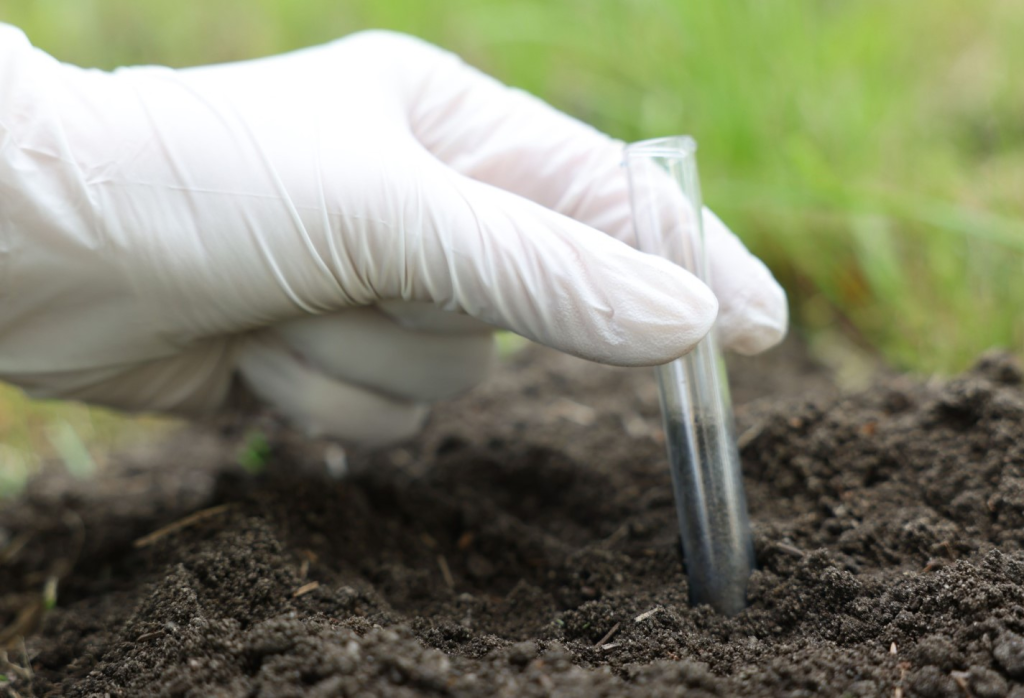
The accuracy of a lab test depends entirely on the quality of the sample. Many maintenance crews take a “surface scrape,” which only shows the chemistry of the mulch layer.
- The 12-Inch Standard: For trees, we must sample at a depth of 6 to 12 inches, where the active fine feeder roots are actually working.
- The Composite Method: A single scoop isn’t enough. We take 5–10 small samples from around the “drip line” of the tree and mix them together to get a true average of the root zone’s chemistry.⁵
4. The Consultant’s Verdict: Data-Driven Stewardship
My role is to act as the bridge between the laboratory and your landscape. A lab report is a list of numbers; a Management Plan is the strategy to fix them. By testing your soil every 2–3 years, we can track the “trend lines” of your soil health, ensuring that your investment in mulch, water, and nutrients is actually reaching the tree.
Professional References
1 Brady, Nyle C. and Weil, Ray R., The Nature and Properties of Soils, 14th Edition, Pearson Education, Page 612.
2 Craul, Phillip J., Urban Soils: Applications and Practices, John Wiley & Sons, Page 128.
3 Harris, Richard W., Arboriculture: Integrated Management of Landscape Trees, Shrubs, and Vines, 4th Edition, Prentice Hall, Page 154.
4 Watson, Gary W., The Root System of Landscape Trees, International Society of Arboriculture, Page 108.
5 Shigo, Alex L., Modern Arboriculture, Shigo and Trees, Associates, Page 144.
Need a Professional 2nd Opinion?
Is your soil a mystery or a measurable asset? At ArborSolutions, we provide the data and technical oversight you need to manage your soil profile with absolute confidence. We do not sell fertilizers, soil amendments, or testing kits. We provide unbiased professional advice and lab-verified diagnostics to ensure your landscape has the foundation it needs to thrive.
Ready to stop the guesswork? Book a Walking-Talking Tour for a site-specific soil diagnostic and a clear, science-based path forward.