Thinning vs. Topping: Identifying the “Contractor Shortcut” That Leads to Structural Failure
In the arboricultural world, there is no practice more universally condemned—yet more frequently performed—than Topping. Across Santa Barbara and San Luis Obispo Counties, you can see the results of this “contractor shortcut” in every neighborhood: trees with flat tops, “knuckles” of decayed wood, and dense, vertical thickets of weak regrowth.
As an independent consultant, I view topping as a form of structural malpractice. It is often sold to property owners as a way to “reduce height” or “make the tree safe,” but the biological reality is exactly the opposite. Topping creates a high-maintenance liability that is far more dangerous than the original canopy.¹
1. The Biology of Topping: A Starvation Response
Topping is the indiscriminate cutting of tree branches to stubs or lateral branches that are not large enough to assume the terminal role. This removes the tree’s “food factories”—the leaves.²
- The Panic Growth: When you top a tree, you strip it of its primary energy source. The tree responds with a desperate survival mechanism: it pushes out hundreds of vertical “epicormic shoots” (water sprouts) to regain its leaf surface as quickly as possible.
- Rapid, Weak Growth: These new shoots can grow 10 to 20 feet in a single season. Because they are not deeply integrated into the tree’s wood—they are merely “stuck” onto the outer bark—they are incredibly prone to snapping during high-wind events.³
2. The Decay Loop
Unlike a proper pruning cut, a “topping cut” is typically made in the middle of a branch, away from the tree’s natural defense zones (the branch collar).
- The Open Door: Because the tree cannot easily seal these large, flat wounds, the wood begins to decay immediately. By the time the new sprouts have grown large and heavy, the wood they are attached to is often hollow or soft with rot.⁴
- The Structural Time Bomb: You now have a heavy, fast-growing canopy attached to a rotting foundation. This is why topped trees are the primary candidates for catastrophic failure during Central Coast winters.
3. The Professional Alternative: Directional Thinning
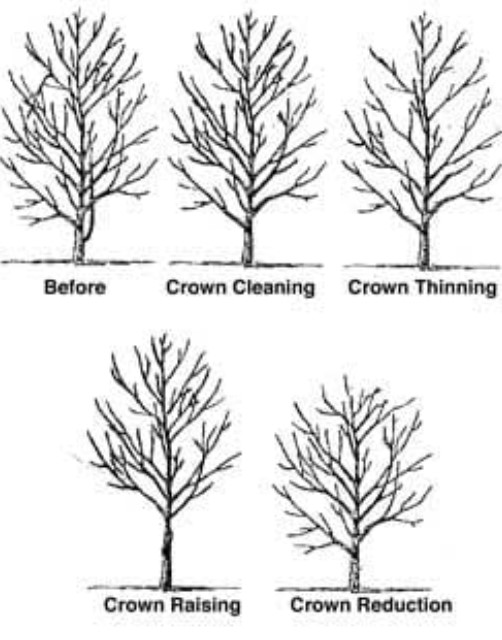
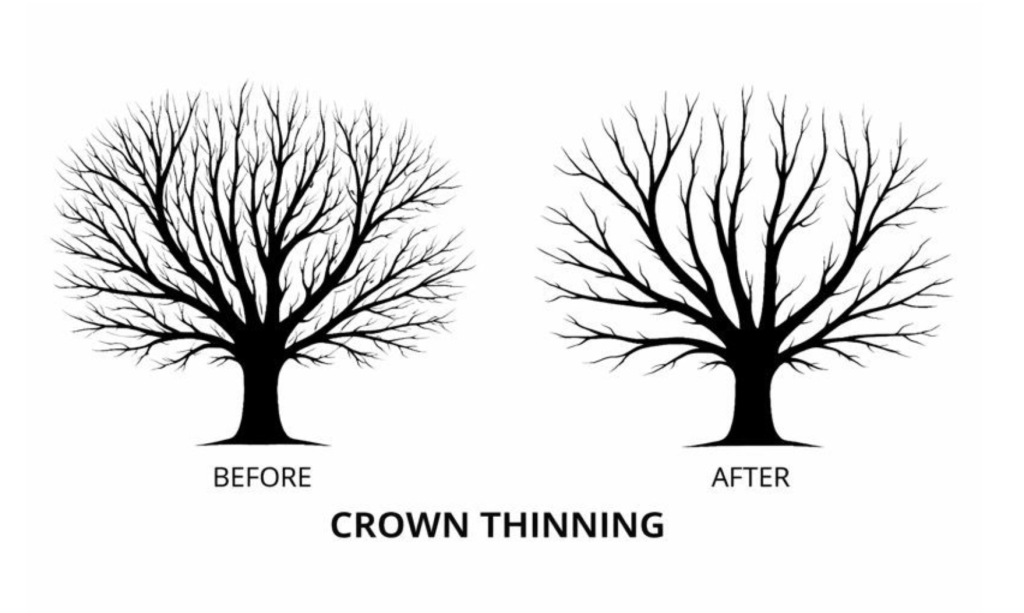
If your goal is to reduce height or clear a view, the science-based alternative is Directional Thinning (also known as drop-crotch pruning).
- The Strategic Cut: We remove a branch back to a “lateral” branch that is at least one-third the diameter of the one being removed. This allows the tree to maintain its natural hormone balance (apical dominance) and redirect energy to the remaining structure.⁵
- Preserving Form: Thinning preserves the tree’s natural shape and aesthetic value while reducing wind resistance (the “sail effect”). A thinned tree looks like it hasn’t been pruned at all—which is the hallmark of a professional job.
4. The Consultant’s Verdict: Topping is More Expensive
Contractors love topping because it is fast, requires zero technical skill, and ensures “repeat business” as the tree aggressively grows back. However, for the property owner, it is a financial trap.
- Increased Frequency: A topped tree must be pruned every 12 to 24 months to manage the sprout growth. A properly thinned tree can often go 3 to 5 years between services.
- Decreased Value: Mature trees add 10% to 20% to property value. A topped tree is a “mutilated” asset and often a net liability in a real estate transaction.
- Hazard Liability: If a topped branch fails and causes damage, the owner (and the contractor) can be held liable for choosing a pruning practice that is officially recognized as substandard.⁶
Professional References
1 Shigo, Alex L., Modern Arboriculture, Shigo and Trees, Associates, Page 156.
2 Harris, Richard W., Arboriculture: Integrated Management of Landscape Trees, Shrubs, and Vines, 4th Edition, Prentice Hall, Page 344.
3 Gilman, Edward F., An Illustrated Guide to Pruning, 3rd Edition, Delmar Cengage Learning, Page 152.
4 Watson, Gary W., The Root System of Landscape Trees, International Society of Arboriculture, Page 164.
5 Costello, Laurence R., Training Young Trees for Structure and Form, University of California Agriculture and Natural Resources, Page 28.
6 International Society of Arboriculture (ISA), Best Management Practices: Tree Pruning, Page 14.
Need a Professional 2nd Opinion?
Has a contractor told you that your tree “needs to be topped” for safety? At ArborSolutions, we provide the technical oversight and specifications you need to achieve your goals without destroying your trees. We do not perform the work ourselves—we act as your neutral advocate to ensure that any pruning on your property meets the highest ISA standards.
Don’t turn your high-value tree into a high-cost hazard. Book a Walking-Talking Tour for a site-specific structural assessment and a clear, science-based path forward.
Request a Walking-Talking Tour at ArborSolutions.pro