
Emitter Placement: Why Watering the Trunk is a Fatal Mistake
In my years as an independent consultant auditing landscapes across Santa Barbara and San Luis Obispo Counties, I have seen thousands of irrigation systems. Some are high-end, Wi-Fi-connected marvels, and others are simple, manual setups. Regardless of the technology, the most common—and most lethal—mistake I encounter is a fundamental misunderstanding of where a tree actually “drinks.”
Many property owners and maintenance crews mistakenly believe that because the trunk is the largest part of the tree, it must be the primary point of hydration. In reality, focusing your irrigation at the base of the trunk is not only inefficient; it is often a death sentence for your high-value botanical assets.
1. The Anatomy of a Drink: Roots vs. Trunk
To understand why placement matters, we have to look at how a tree is built. The trunk is primarily composed of heartwood (support) and sapwood (transport). The “mouth” of the tree, however, is located at the root tips. These fine, microscopic root hairs are located far from the trunk, extending out toward—and often well beyond—the Drip Line (the edge of the tree’s leaf canopy).
- The Absorption Zone: The roots closest to the trunk are large, woody “anchor roots.” Their job is stability, not hydration. The roots that actually absorb water and nutrients are the younger, more flexible feeder roots located in the outer 50% of the root zone and beyond.[^1]
- The Danger Zone: The area where the trunk meets the soil is called the Root Flare. This area is biologically designed to be dry. It needs oxygen exchange through the bark to remain healthy. When you keep this area saturated, you are essentially suffocating the tree.
2. The Fatal Consequence: Root Flare Rot
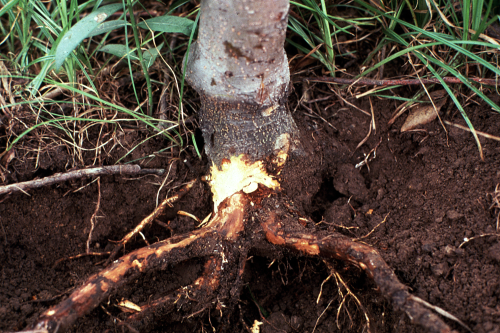
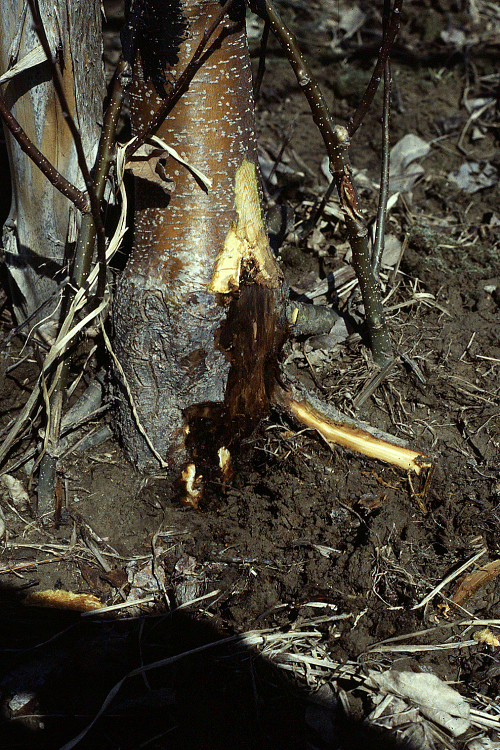
When emitters (drip or spray) are placed directly against the bark of the trunk, you create a localized environment of “permanent saturation.” On the Central Coast, where we deal with heavy Adobe clay soils that hold moisture for days, this leads to two primary killers:
- Phytophthora (Root Rot): This water-borne pathogen thrives in soggy, poorly aerated soil. It attacks the bark at the base of the tree, girdling the trunk and cutting off the tree’s ability to move nutrients between the leaves and roots.
- Armillaria (Oak Root Fungus): For our iconic Coast Live Oaks, a wet trunk is an invitation for Armillaria. This fungus is native to our soils but only becomes a “predator” when the tree is stressed by summer water. Once it takes hold in the root flare, the tree becomes a significant structural risk, often failing at the base without warning.
3. The Professional Strategy: Moving the Water Out
As the tree grows, its irrigation system must “migrate” with it. If you have a mature tree that still has emitters installed from when it was a 15-gallon sapling, those emitters are now in the wrong place, delivering water to a zone that no longer needs it and creating a disease reservoir.
- The 50/50 Rule: As a general guide, place emitters in the outer half of the area under the canopy. This encourages the roots to grow outward, creating a wider, more stable structural base for the tree.
- The “Dry Flare” Mandate: There should be a minimum of 18 to 24 inches of bone-dry soil immediately surrounding the trunk of a mature tree. If you see moss, algae, or dark “water staining” growing on the bark, your emitters are dangerously close.
- The Spiral Method: For large specimen trees, I recommend a “spiral” of drip tubing that starts midway to the drip line and winds outward. This ensures that as the root system expands, the water delivery is already there to meet it.
4. The Hidden Benefit: Structural Integrity
By placing water further away from the trunk, you aren’t just protecting the bark from rot; you are training the tree to be more drought-resilient and wind-firm. Roots grow toward moisture. By “luring” the roots away from the center, you create a sprawling, interconnected root mat that can better withstand the high winds we see during our Central Coast winter storms.[^2]
Professional Footnotes
[^1]: Based on ANSI A300 (Part 2) Standards for soil management and irrigation practices. [^2]: Consultant Note: Structural stability is directly linked to the “Root-to-Canopy” ratio, which is optimized by wide-pattern irrigation and proper moisture placement.
Need a Professional 2nd Opinion?
The information above is a general guide, but every landscape is a complex, living system—and irrigation placement is one of the most frequent causes of “Sudden Oak Death” lookalikes and catastrophic structural failures.
At ArborSolutions, we do not sell tree removal, planting, or irrigation hardware. We provide unbiased data and professional advice so you can make confident decisions based on the actual health of your trees, not a sales quota or a contractor’s shortcut.
Are your emitters too close to your high-value assets? Book a Walking-Talking Tour for a site-specific diagnostic and a clear, science-based path forward to protect your canopy for the next generation.