
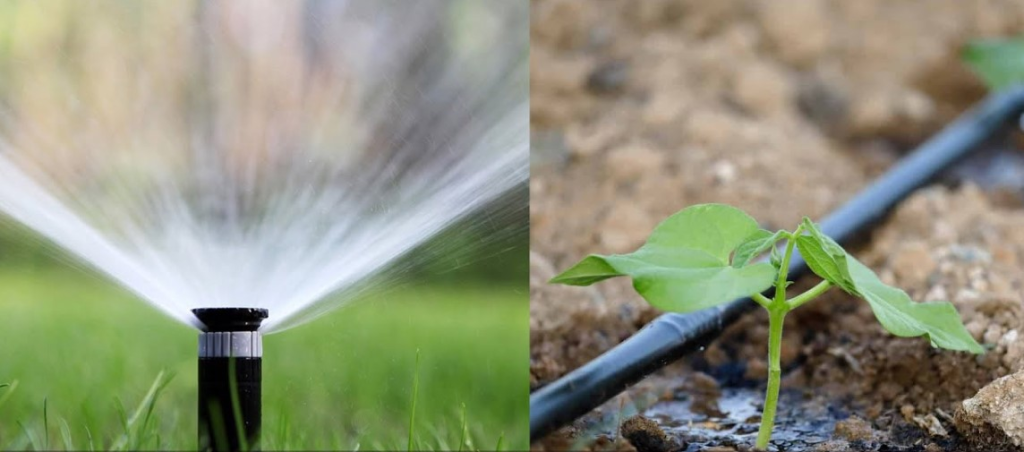
Drip vs. Spray: Which System is Right for Your Landscape?
In the Central Coast’s Mediterranean climate, irrigation isn’t just about keeping plants green; it’s about managing a finite resource against challenging soil conditions. Whether you are navigating the heavy Adobe clays of the Santa Ynez Valley or the porous sands of Nipomo, choosing between Drip and Spray irrigation is the most consequential decision you will make for your landscape’s long-term health.
As an independent consultant, I view irrigation through the lens of Efficiency vs. Efficacy. Here is the breakdown of how these two systems perform in our local environment.
1. Drip Irrigation: Precision at the Root
Drip irrigation delivers water at low pressure directly to the soil surface or subsurface near the plant’s root zone.
Why It Works for the Central Coast:
- Precision and Runoff Control: Our local clay soils have slow infiltration rates. Drip systems emit water slowly enough to prevent the “river effect” often seen on slopes in the Santa Barbara foothills.
- Reduced Weed Pressure: Because water is only applied where your desired plants live, the germination of weeds in open spaces is significantly reduced.
- Water Conservation: By eliminating evaporation from wind and overspray, drip systems are often 30% to 50% more efficient than traditional spray.
The Consultant’s Warning:
Drip systems are “out of sight, out of mind.” Without a professional maintenance audit, a clogged emitter or a rodent-chewed line can go unnoticed until a high-value tree shows signs of stress. Regular pressure checks and filter cleanings are non-negotiable.
2. Spray Irrigation: Coverage and Visibility
Traditional spray systems (rotors and fixed pop-ups) distribute water through the air in a defined pattern.
When to Choose Spray:
- Groundcovers and Turf: For uniform coverage over large, low-profile areas, spray remains the industry standard.
- Visual Monitoring: It is easy for a property owner to see a broken spray head. The “instant feedback” of a spray system makes it easier to troubleshoot.
- Salt Management: In coastal zones like Pismo Beach, occasional overhead spray can help rinse salt spray off the foliage of sensitive species.
The Efficiency Trap:
On the Central Coast, wind-drift is a major factor. A significant percentage of spray-applied water is lost to the atmosphere before it ever touches the soil.
The “Independent Verdict”: Which is Better?
For most Central Coast applications—specifically for trees and ornamental shrubs—Drip Irrigation is the superior choice for plant health and water budget management. However, a “Hybrid” approach is often the smartest move for complex properties.
Quick Decision Matrix:
- Best Soil Match: Drip (Clay/Silt) vs. Spray (Sand/Loam)
- Infiltration Rate: Drip (Slow & Steady) vs. Spray (Rapid & High-Volume)
- Evaporation Risk: Drip (Low) vs. Spray (High)
Professional Footnotes
- : Efficiency ratings based on California Department of Water Resources (DWR) standards for Mediterranean climates.
- Consultant Note: Reclaimed municipal water high in salts may require specific leaching fractions to prevent soil toxicity.
Need a Professional 2nd Opinion?
The information above is a general guide, but every landscape is a complex, living system—and irrigation is where small mistakes quietly become expensive ones.
At ArborSolutions, we do not sell tree work or landscaping services. We provide unbiased data and professional advice so you can make confident decisions without guesswork.
Ready to dial in your irrigation and protect your landscape investment? Book a Walking-Talking Tour for a site-specific diagnostic and a clear, science-based path forward.