
Hydrophobic Soil: When Water Rolls Right Off the Dirt
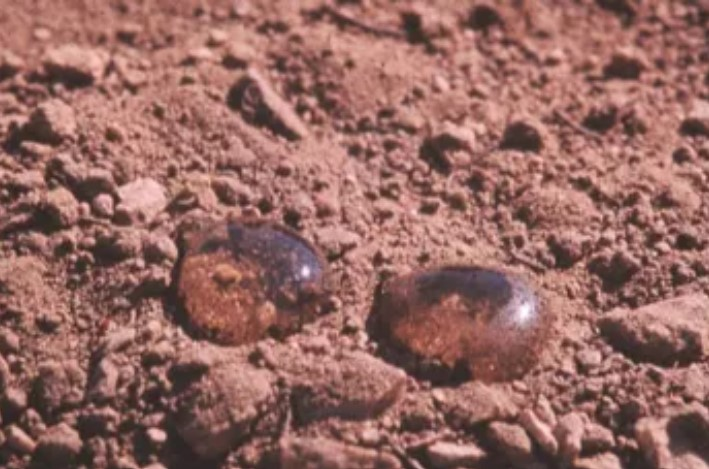
There is a specific, persistent frustration unique to Central Coast gardening: standing over a parched landscape with a hose, only to watch the water bead up and roll across the surface like it is hitting a freshly waxed car. This isn’t just “dry soil”—this is Hydrophobic Soil.
As an independent consultant, I often find that property owners in Santa Barbara and San Luis Obispo Counties respond to this by simply turning up their irrigation timers. Unfortunately, if the soil is truly hydrophobic, adding more water at a higher frequency only leads to expensive runoff and wasted resources. To solve the problem, we have to address the chemistry of the soil surface itself.¹
1. The Waxy Shield: Why Soil Repels Water
Hydrophobicity occurs when soil particles become coated in a thin, waxy layer of organic acids. These waxes are typically the byproduct of decomposed plant matter or the drying out of specific fungal colonies. Under normal conditions, these waxes are harmless; however, during our long, hot Central Coast summers, the soil can reach a level of “critical dryness” where these organic coatings harden and become water-repellent.²
- The Wildfire Connection: For properties in the foothills that have experienced recent brush fires, hydrophobicity is a major risk. Intense heat vaporizes organic compounds which then settle and condense into a water-proof layer just below the soil surface.³
- The Drought Cycle: Extended periods without rain allow these waxy coatings to “set,” making the first rains of winter or the first irrigation cycles of spring almost entirely ineffective.
2. The Diagnosis: The Water Drop Penetration Time (WDPT) Test
Before you invest in expensive soil amendments, you can perform a simple diagnostic at home. Clear away the mulch and place a few drops of water onto the bare soil.
- Healthy Soil: The water should soak in within 5 to 10 seconds.
- Moderate Hydrophobicity: The water beads for 30 to 60 seconds.
- Severe Hydrophobicity: The water remains as a bead for several minutes or more.
If your soil fails this test, your current irrigation schedule is likely wasting 50% or more of your water to surface runoff.⁴
3. Strategies for Breaking the Barrier
Breaking the hydrophobic seal requires a tactical approach. Simply “flooding” the area will not work; the water will follow the path of least resistance and move into cracks or down slopes without ever hydrating the root zone.
- The Cycle & Soak Method: As discussed in our primary Irrigation Pillar, applying water in short bursts (cycling) allows the first layer of moisture to “soften” the waxy coating, enabling the second and third cycles to actually penetrate the profile.
- Wetting Agents (Surfactants): Think of these as “soil soap.” These products break the surface tension of the water, allowing it to move through the waxy organic layer and into the soil particles.
- The Mulch Buffer: Maintaining a 3-to-4-inch layer of organic arborist wood chips helps retain “residual moisture.” Hydrophobicity rarely occurs in soil that stays consistently, even if only slightly, moist.⁵
4. The Consultant’s Verdict: Strategy Over Saturation
I frequently see “mow-and-blow” crews trying to fix hydrophobic patches by digging deep trenches or over-applying high-nitrogen fertilizers. These are often temporary fixes that don’t address the root cause. A professional soil strategy focuses on increasing organic matter and utilizing low-volume delivery systems that give the soil the time it needs to accept hydration.
Professional References
1 Brady, Nyle C. and Weil, Ray R., The Nature and Properties of Soils, 14th Edition, Pearson Education, Page 218.
2 Neary, Daniel G., Wildfire’s Effects on Ecosystems, USDA Forest Service, Page 64.
3 Harris, Richard W., Arboriculture: Integrated Management of Landscape Trees, Shrubs, and Vines, 4th Edition, Prentice Hall, Page 156.
4 Shigo, Alex L., Modern Arboriculture, Shigo and Trees, Associates, Page 112.
5 Craul, Phillip J., Urban Soils: Applications and Practices, John Wiley & Sons, Page 284.
Need a Professional 2nd Opinion?
The information above is a general guide, but hydrophobic soil is a site-specific challenge that can vary from one side of your property to the other. Mistakes in managing this condition lead to wasted water, dead plants, and unnecessary erosion.
At ArborSolutions, we provide the data you need to fix your soil without the conflict of interest. We do not sell wetting agents, soil amendments, or irrigation hardware. We offer unbiased professional advice to help you make confident decisions for your property’s long-term health.
Is your water rolling off instead of soaking in? Book a Walking-Talking Tour for a site-specific diagnostic and a clear, science-based path forward.