
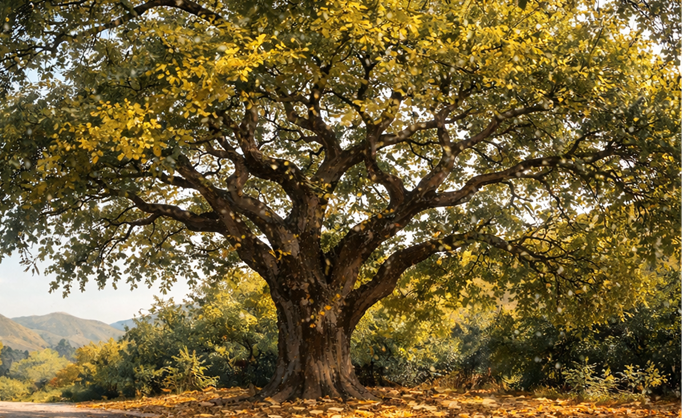
The Diagnostic: Right around March and April, many homeowners on the Central Coast panic. Their magnificent Coast Live Oaks (Quercus agrifolia) suddenly look like they are failing. The leaves turn a mottled yellow or brown and drop in large numbers, littering the driveway and lawn.
The Science: Unlike deciduous trees that drop their leaves in autumn, our native Oaks perform a “rolling exchange” in the spring. As the tree pushes out new buds, it aggressively pulls nutrients (like nitrogen and phosphorus) out of its older, two-year-old leaves to fuel the new growth. This internal withdrawal of nutrients is exactly what causes the yellowing. It is a brilliant survival mechanism, not a disease.
The Red Flags:
- Normal: Leaf drop is accompanied by tiny, bright green clusters of new leaves at the branch tips.
- Abnormal: The branch tips are completely brittle and snap easily, with no new green growth visible anywhere on the canopy.
The ArborSolutions Guide’s Action: Do not apply nitrogen-heavy fertilizer during this phase. Forced, unnatural growth at this time can lead to “soft” foliage that is highly susceptible to aphids and mildew. Let the tree complete its natural cycle.
Professional Footnotes & References
- Matheny, N. P., & Clark, J. R. (1994). A Photographic Guide to the Evaluation of Hazard Trees in Urban Areas.
- University of California Statewide IPM Program (UC IPM). “Pests in Landscapes and Gardens: Oak & Sycamore Diagnostics.”
- International Society of Arboriculture (ISA). “Best Management Practices: Tree Risk Assessment and Structural Mechanics.”
🔍 Need a Professional 2nd Opinion?
The information above serves as a general guide, but every tree is a complex, individual living system. If you are seeing these red flags on your property, don’t leave the health and safety of your landscape to guesswork.
At ArborSolutions, we do not sell or perform tree removal or trimming services. We provide unbiased data and professional advice. We like to think of ourselves as the second opinion go-to before any major tree work decisions are made.
Ready to walk your property? Book a “Walking-Talking Tour” for a site-specific diagnostic and a clear, science-based path forward.