Post-Storm Recovery: The 48-Hour Checklist
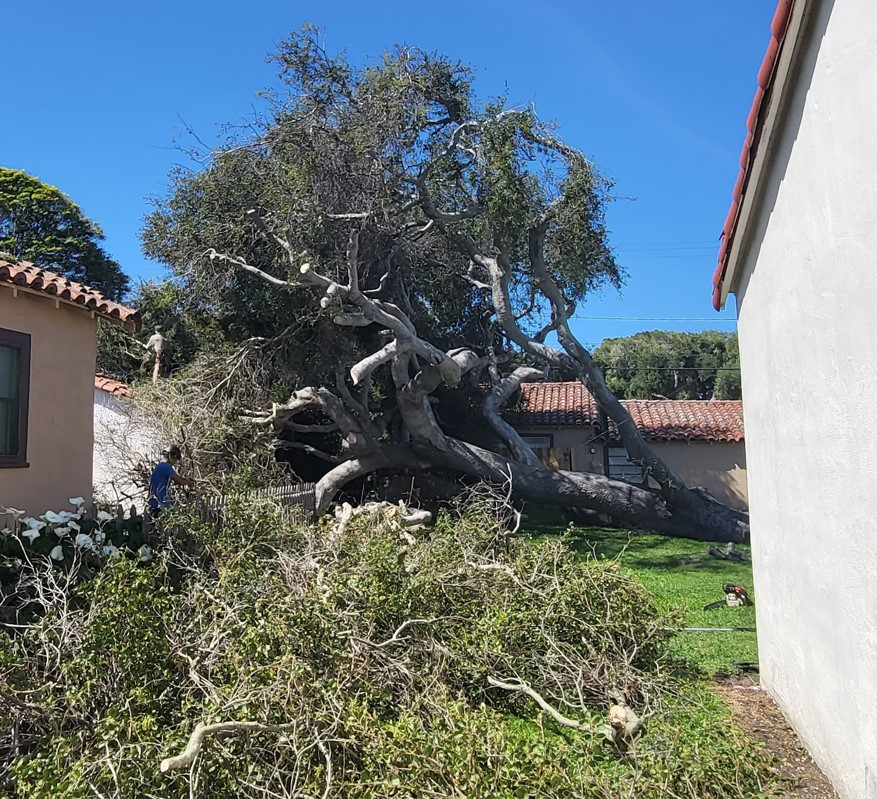
The 48 hours following a major Central Coast storm are the most critical for property safety and tree preservation. In the aftermath of the high-velocity “Sundowner” winds in Santa Barbara or the heavy atmospheric rivers that saturate the soils of San Luis Obispo, trees that appear “fine” may actually be in a state of active failure.
As an independent consultant, I view post-storm recovery as a race against gravity. Identifying the subtle signs of “heaving” soil or a detached “hanger” before the next gust of wind can prevent catastrophic property damage and personal injury.¹
1. The Ground Check: Identifying “Heaving” Soil
When the soil is fully saturated, it loses its “shear strength.” A tree that was stable in dry dirt can suddenly act like a sail, with its root plate rocking back and forth in the mud.
- Look for the “Smile”: Walk the perimeter of the tree’s trunk flare. Look for fresh cracks in the soil or a crescent-shaped mound of dirt lifting on the windward side. This is “heaving,” and it indicates the root system has partially detached from the earth.²
- Buckling Hardscape: If a nearby sidewalk or driveway has suddenly lifted or cracked after a storm, it is often a sign that the root plate has shifted.
- The Vertical Test: Is the tree leaning more than it was 48 hours ago? Use a fixed object (like a fence post or a house corner) as a reference point. A new lean in saturated soil is a structural emergency.
2. The Canopy Check: Hunting for “Hangers”
“Hangers” (or widowmakers) are branches that have snapped but are still caught in the upper canopy. These are gravity-driven liabilities that can fall without warning, even days after the wind has died down.³
- The Visual Sweep: Using binoculars, scan the canopy for “off-color” foliage. A branch that is suddenly turning brown or gray usually indicates a clean break that is no longer receiving sap.
- Leaning Limbs: Look for branches that are resting on other branches at unnatural angles.
- Bark Tears: Check the main trunk for fresh, white “scars” or stripped bark. This often marks the path where a heavy limb has partially failed and slid down the tree.⁴
3. The Drainage Audit: Preventing “Anaerobic” Decline
Storm recovery isn’t just about structural failure; it’s about biological health. Standing water against a trunk for more than 48 hours can trigger rapid root decay.
- Clear the Flare: Ensure that mulch or debris hasn’t washed up against the “root flare” (the base of the tree). Moisture trapped here leads to Phytophthora (crown rot).
- Drainage Release: If water is pooling within the “drip line” of your high-value oaks, manually clear small drainage paths to move that water away from the root zone.⁵
4. The Consultant’s Verdict: Don’t Rush to the Chainsaw
I frequently see “emergency” crews removing entire trees after a storm because of a single broken limb. In the chaos of recovery, many healthy assets are lost to reactive fear.
- Safety First: Never attempt to remove a “hanger” yourself. These are under extreme tension and can “barber-chair” or kick back with lethal force.
- Professional Assessment: Before you agree to a total removal, have a TRAQ-Qualified Arborist perform a Level 2 Basic Assessment. Many trees can be saved through structural “reduction cuts” and supplemental cabling rather than being cut to the stump.⁶
Professional References
1 Harris, Richard W., Arboriculture: Integrated Management of Landscape Trees, Shrubs, and Vines, 4th Edition, Prentice Hall, Page 498.
2 Matheny, Nelda and Clark, James R., A Photographic Guide to the Evaluation of Hazard Trees in Urban Areas, ISA, Page 22.
3 Shigo, Alex L., Modern Arboriculture, Shigo and Trees, Associates, Page 242.
4 Gilman, Edward F., An Illustrated Guide to Pruning, 3rd Edition, Delmar Cengage Learning, Page 164.
5 Watson, Gary W., The Root System of Landscape Trees, International Society of Arboriculture, Page 158. 6 International Society of Arboriculture (ISA), Best Management Practices: Tree Risk Assessment, Page 18.
Need a Professional 2nd Opinion?
The aftermath of a storm is the worst time to make a permanent decision about a mature tree. At ArborSolutions, we provide the neutral, expert risk assessment you need to separate real hazards from manageable damage.
We do not perform emergency removals or cleanup. We provide unbiased professional advice to help you protect your property and preserve your high-value trees whenever possible.
Does your tree have a new lean or a suspicious “hanger”? Book a Walking-Talking Tour for an immediate post-storm structural diagnostic and a clear, science-based path forward.