Managing Storm Limbs: The “Three-Cut Method” for Removing Broken Branches Safely
Following a major Central Coast storm, many property owners in Santa Barbara and San Luis Obispo take to their landscapes with a hand saw or chainsaw to “clean up” broken limbs. While the intention is good, an improper cut on a heavy, storm-damaged branch can cause more damage to the tree than the storm itself.
As an independent consultant, I frequently see “peeled” bark and jagged wounds caused by a single downward cut. This is not just a cosmetic issue; it destroys the tree’s natural defense systems. To protect your assets, every branch removal must follow the industry-standard **Three-Cut Method.**¹
1. The Physics of the “Bark Tear”
Wood is heavy, and storm-damaged limbs are often under extreme tension. If you attempt to remove a branch with one simple cut from the top, the weight of the limb will cause it to snap and fall before the cut is finished.
- The Result: The falling limb peels a long strip of bark and living tissue (the cambium) down the side of the main trunk.
- The Long-Term Damage: This “bark tear” creates a massive wound that the tree may never be able to seal, providing an open door for wood-decay fungi and boring insects.²
2. The Three-Cut Method: Step-by-Step
This technique uses physics to neutralize the weight of the limb before the final, precise cut is made.
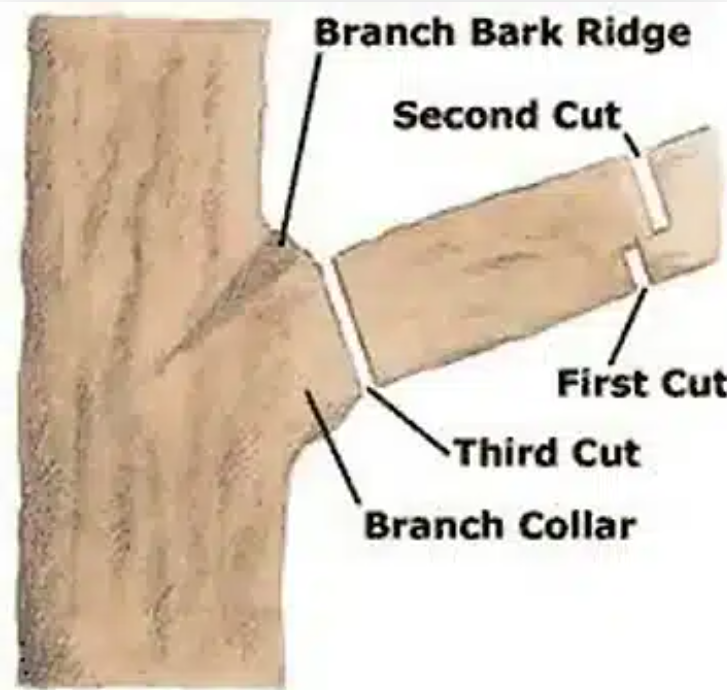
Cut 1: The Undercut (The “Anti-Peel” Cut)
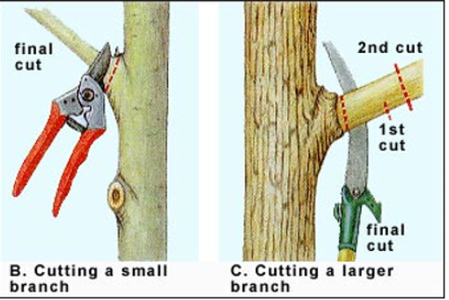
Go about 12 to 15 inches out from the trunk. Make a cut on the bottom of the branch, going about one-third of the way through. This creates a “break point” that prevents a bark tear from traveling back to the trunk.³
Cut 2: The Top Cut (The Removal)
Move an inch or two further out the limb from your first cut. Cut all the way through the branch from the top. As the limb falls, it will snap cleanly at your first undercut. You are now left with a short, lightweight “stub” attached to the tree.
Cut 3: The Finish Cut (The “Collar” Cut)
Now that the weight is gone, you can make a precise final cut. Locate the Branch Bark Ridge and the Branch Collar (the shoulder of wood where the branch meets the trunk). Make your cut just outside this collar.⁴
3. Why the “Stub” Must Go
I often see homeowners leave 6-inch stubs because they are afraid of cutting too close to the trunk. However, a stub is a biological “dead end.”
- No Seal: The tree cannot grow a callus roll over a long stub. Instead, the stub dies and rots, eventually funneling decay directly into the heartwood of the main trunk.⁵
- The Target: Proper pruning targets the “collar,” which contains a high concentration of chemically active cells designed to wall off decay (CODIT).
4. The Consultant’s Verdict: Know Your Limits
The Three-Cut Method is essential for any branch larger than one inch in diameter. However, storm-damaged limbs are unpredictable.
- Tension and Compression: If a limb is pinned under another branch or twisted, it can “spring” back with lethal force when cut.
- The 15-Foot Rule: If you cannot reach the limb while standing firmly on the ground, do not attempt the cut yourself.
- Safety First: At ArborSolutions, our role is to provide the Pruning Specifications and safety oversight. We identify which limbs can be handled by a homeowner and which require a specialized, insured climbing crew with aerial lifts.
Professional References
1 Harris, Richard W., Arboriculture: Integrated Management of Landscape Trees, Shrubs, and Vines, 4th Edition, Prentice Hall, Page 338.
2 Shigo, Alex L., Modern Arboriculture, Shigo and Trees, Associates, Page 224.
3 Gilman, Edward F., An Illustrated Guide to Pruning, 3rd Edition, Delmar Cengage Learning, Page 142.
4 International Society of Arboriculture (ISA), Best Management Practices: Tree Pruning, Page 18.
5 Watson, Gary W., The Root System of Landscape Trees, International Society of Arboriculture, Page 168
Need a Professional 2nd Opinion?
Is your storm cleanup protecting your trees or creating future hazards? At ArborSolutions, we provide the neutral, expert oversight you need to manage post-storm recovery with confidence.
We do not perform the cutting ourselves—we act as your neutral advocate to ensure every cut made on your property follows the highest ISA standards. Ready to ensure your trees survive the next decade, not just the next week? Book a Walking-Talking Tour for a site-specific storm assessment and a clear, science-based path forward.