
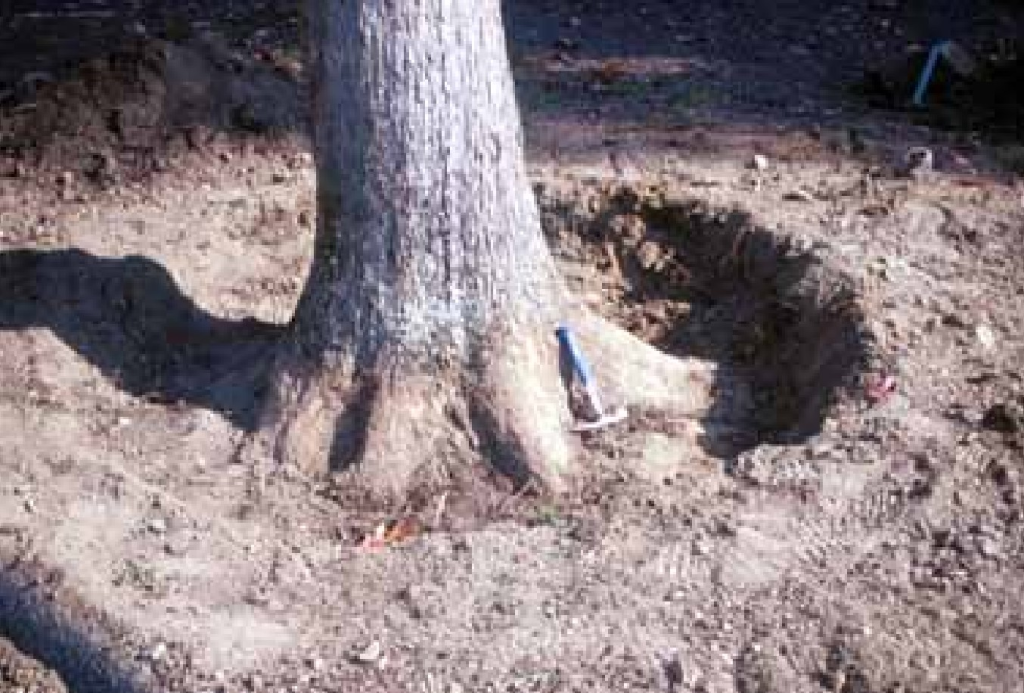
Watering Mature Oaks: The “Dry Root Flare” Rule
If you own a property on the California Central Coast, the Coast Live Oak (Quercus agrifolia) isn’t just a tree—it’s a high-value biological asset. These iconic giants have evolved over millennia to thrive in our specific Mediterranean climate, characterized by bone-dry summers and cool, wet winters. Yet, in my 25+ years as an independent consultant, I’ve found that the #1 cause of mature Oak failure isn’t drought or pests—it is mismanaged supplemental irrigation.
To protect your canopy, you must understand the “Dry Root Flare” Rule. Failure to follow this single principle is the most common reason for “Sudden Oak Death” lookalikes and catastrophic structural failures in Santa Barbara and San Luis Obispo Counties.
1. The Anatomy of the Kill Zone: What is the Root Flare?
The Root Flare (or trunk flare) is the critical transition zone where the vertical trunk widens and enters the soil to become the root system. Unlike the deep “anchor roots,” the bark at the root flare is biologically programmed to be exposed to air. It requires constant oxygen exchange (respiration) to maintain its structural integrity.
When this area is kept artificially wet—whether by a “dumb” irrigation timer, heavy mulch, or poor drainage—the bark stays soft and saturated. This creates an open door for the two most aggressive pathogens in our local soil.
2. The Primary Killers: Phytophthora & Armillaria
In the heavy Adobe clays of the Santa Ynez Valley and the coastal foothills, two soil-borne pathogens wait for property owners to make a watering mistake.
- Phytophthora (Root Rot): This water-mold pathogen thrives in soggy, anaerobic (oxygen-poor) soil. It attacks the cambium layer—the “veins” of the tree—effectively girdling the Oak at the base. By the time you see the leaves turning yellow, the tree’s “plumbing” has often already been destroyed.
- Armillaria (Oak Root Fungus): This fungus is a natural part of our local ecology and is present in nearly all Central Coast soils. When the soil is dry, it remains dormant. However, summer irrigation “wakes up” the fungus, allowing it to aggressively consume the living wood of the flare. This leads to “white rot,” which turns the base of the tree into a spongy, structurally unsound mess.[^1]
3. The “6-Foot Rule”: Professional Emitter Placement
To be a responsible steward of a mature Oak, you must establish a Protected Zone that remains untouched by supplemental water during the dry months (May through October).
- The Bone-Dry Zone: There should be zero supplemental irrigation (emitters, sprays, or bubblers) within 6 to 10 feet of the trunk. If you see moss, algae, or dark “water staining” on the bark, your tree is in immediate danger.
- Target the Drip Line: If the tree is showing signs of extreme drought stress, water should only be applied at the Drip Line (the outer edge of the leaf canopy). This is where the fine “feeder roots” are located.
- Deep and Infrequent: Mature Oaks prefer “seasonal mimicry.” If you must water during a multi-year drought, use low-flow drip emitters for several hours once every 4–6 weeks. This allows the water to penetrate deep into the profile without saturating the surface flare.[^2]
4. Under-Oak Landscaping: The “Dry Palette”
The fastest way to kill a mature Oak is to install a high-water lawn or thirsty ornamental shrubs beneath its canopy. The constant moisture required to keep a lawn green is a death sentence for an Oak.
Instead, utilize a “Dry Palette” of native species that evolved to live in the same dry root zones. These plants provide aesthetic value without compromising the tree’s structural stability:
- Hummingbird Sage (Salvia spathacea)
- Coffeeberry (Frangula californica)
- Island Alumroot (Heuchera maxima)
Professional Footnotes
[^1]: Based on the University of California Integrated Pest Management (UC IPM) standards for Quercus agrifolia. [^2]: Consultant Note: Structural integrity in Oaks is often compromised 5–10 years before the canopy shows visible stress. Early diagnostic is key to asset protection.
Need a Professional 2nd Opinion?
The information above is a general guide, but every mature Oak is a complex, high-value asset that requires a site-specific diagnostic. Irrigation mistakes made today can take a decade to manifest, often resulting in a tree that is too far gone to save by the time you notice the symptoms.
At ArborSolutions, we provide the data you need without the conflict of interest. We do not sell tree removal, pruning, or landscaping services. We offer unbiased professional advice to help you make confident decisions for your property’s long-term value.
Do you have high-value Oaks near irrigated zones? Book a Walking-Talking Tour for a site-specific diagnostic to protect your canopy for the next generation.