
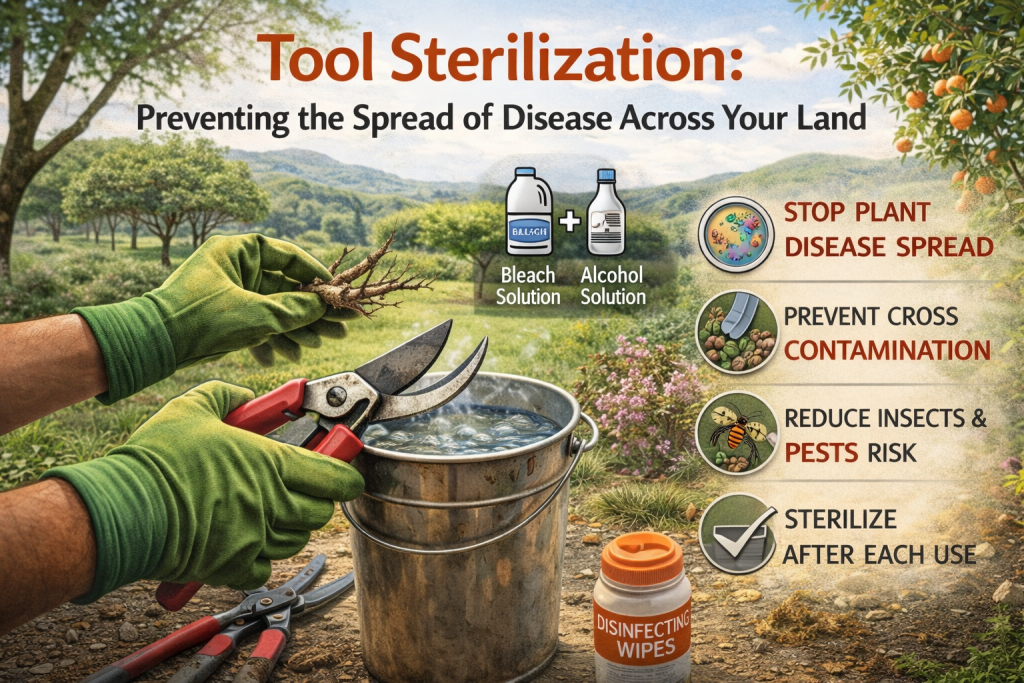
Tool Sterilization: Preventing the Spread of Disease Across Your Land
In the professional tree care industry, we often focus on the “big” tools—the chainsaws, the chippers, and the bucket trucks. However, the most dangerous tool on your property is often the simplest: a pair of unsterilized hand pruners. In Santa Barbara and San Luis Obispo Counties, where pathogens like Fusarium Wilt and Fire Blight are endemic, a single contaminated cut can be the “Patient Zero” for a landscape-wide epidemic.¹
As an independent consultant, I view tool sterilization as the “biological firewall” of your property. If your maintenance crew is moving from a diseased tree to a healthy one without disinfecting their blades, they aren’t just pruning your landscape—they are inoculating it with a death sentence.
1. The High-Stakes Pathogens: Fusarium and Fire Blight
Two of our region’s most aggressive diseases are easily spread via contaminated metal.
- Fusarium Wilt (Fusarium oxysporum): This fungal pathogen is a major threat to our iconic Canary Island Date Palms. It invades the tree’s vascular system (the “veins”), clogging it until the tree dies of thirst. Once a palm is infected by a contaminated chainsaw, there is no cure.²
- Fire Blight (Erwinia amylovora): Common in pears, apples, and pyracantha, this bacterial disease causes branches to look “scorched.” The bacteria ooze from active cankers and stick to pruning shears, hitchhiking to the next healthy branch with every cut.³
2. The “Hitchhiker” Effect
Pathogens are invisible. A pruning blade that looks “clean” can actually harbor millions of microscopic spores or bacteria.
- Vascular Transfer: When a blade cuts through an infected branch, it picks up infected sap. When that same blade enters the living tissue of the next tree, it bypasses the tree’s outer bark—the “immune system”—and injects the pathogen directly into the bloodstream of the plant.⁴
- Soil-Borne Risks: It’s not just the canopy. Shovels, trowels, and even the tires of heavy machinery can transport Phytophthora (root rot) from one area of your property to another.
3. Sterilization Protocols: The Arborist’s Standard
To protect your investment, your maintenance contract should include a mandatory sterilization clause. It only takes 30 seconds to save a multi-thousand-dollar tree.
- The Disinfectant Choice: * 70% Isopropyl Alcohol: The gold standard. It is effective, evaporates quickly, and is less corrosive to metal than bleach.
- 10% Bleach Solution: Highly effective but requires a 1-to-2-minute soak and can pit or rust high-carbon steel blades if not rinsed.⁵
- Lysol/Clorox Wipes: Acceptable for small hand tools, though they require longer contact time to ensure a full “kill” of the pathogen.
- The “Between Every Tree” Rule: Tools must be sterilized before moving from one tree to the next. For high-risk species like Palms or Pears, I recommend sterilizing between every single cut.
4. The Consultant’s Verdict: Oversight is Key
I frequently see “mow-and-blow” crews move through an entire neighborhood with the same equipment, never stopping to clean a blade. This is how “neighborhood-wide” declines happen.
As your independent consultant, my role is to establish the Bio-Security Protocol for your property. I provide the training and the technical specifications that your crews must follow. We ensure that the people you hire to maintain your assets aren’t inadvertently destroying them.
Professional References
1 Harris, Richard W., Arboriculture: Integrated Management of Landscape Trees, Shrubs, and Vines, 4th Edition, Prentice Hall, Page 482.
2 Costello, Laurence R., Abiotic Disorders of Landscape Plants: A Diagnostic Guide, University of California Agriculture and Natural Resources, Page 156.
3 Shigo, Alex L., Modern Arboriculture, Shigo and Trees, Associates, Page 174.
4 Watson, Gary W., The Root System of Landscape Trees, International Society of Arboriculture, Page 122.
5 International Society of Arboriculture (ISA), Best Management Practices: Tree Pruning, Page 24.
Need a Professional 2nd Opinion?
Is your maintenance crew practicing “clean” arboriculture, or are they spreading pathogens across your land? At ArborSolutions, we provide the technical oversight and bio-security specifications you need to protect your landscape from the “silent spread” of disease.
We do not perform maintenance or sell chemicals. We provide unbiased professional advice to ensure that every cut made on your property is a healthy one.
Concerned about a tree that seems to be declining for no reason? Book a Walking-Talking Tour for a site-specific diagnostic and a clear, science-based path forward.