The Myth of “Black Gold”: Why Over-Amending Planting Holes Fails
One of the most persistent “garden myths” on the Central Coast is that if you have heavy clay or poor sand, you should dig a massive hole and fill it with bags of rich, dark potting soil or “Black Gold” compost. While this feels like a kindness to a new tree—giving it a “head start” in a luxurious environment—it is often a recipe for long-term physiological failure.¹
As an independent consultant, I view the planting hole as a transition zone, not an isolated pot. When you create a pocket of perfect soil surrounded by tough, native Santa Barbara Adobe clay or compacted inland soils, you create a physical and chemical boundary that the tree may never overcome.
1. The “Bathtub Effect”
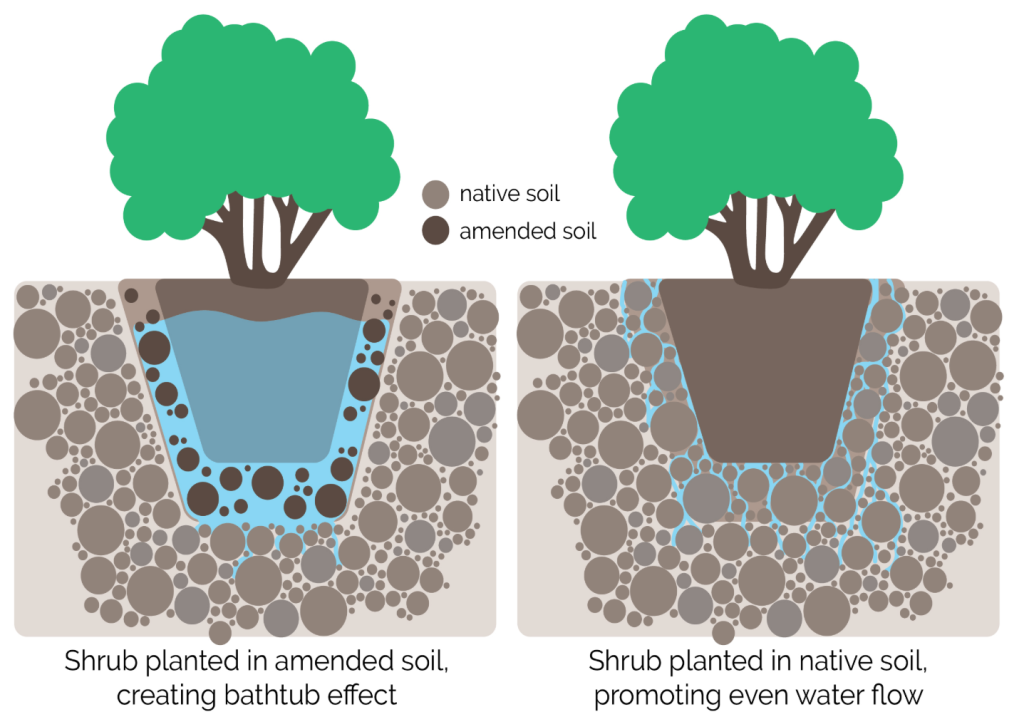
In the heavy clays common to San Luis Obispo and Santa Maria, water moves at vastly different speeds through different soil textures. Fluffy, organic amendments are highly porous, while native clay is dense and slow-draining.
- Hydraulic Trap: When it rains or you irrigate, water moves rapidly through the amended “Black Gold” but hits the clay walls like a brick. The water pools at the bottom of the hole because it cannot infiltrate the native soil fast enough.²
- Root Suffocation: The tree essentially sits in a subterranean bathtub. Because roots require oxygen to survive, they eventually drown in the standing water, leading to root rot and a rapid decline that most owners mistake for “drought stress.”
2. The “Lazy Root” Syndrome
Tree roots are biologically opportunistic; they follow the path of least resistance. If you provide a pocket of rich, soft soil, the roots have no incentive to push out into the challenging, unamended native ground.
- Pot-Bound in the Ground: I have performed site audits on ten-year-old trees that blew over in a storm, only to find the roots were still circling within the original amended planting hole.³ They never established the sprawling, structural foundation needed to withstand Central Coast wind events.
- Interface Barriers: The sharp change in texture between the “good” soil and “bad” soil creates a physical barrier. Roots often hit that transition point and turn back inward, creating girdling roots that can eventually strangle the trunk.
3. The Consultant’s Strategy: Native is Better
The goal of planting is to get the tree adjusted to the reality of your site as quickly as possible. If a tree cannot survive in your native soil, it is either the wrong species for the location or the soil requires broad-scale remediation, not a localized “pocket” of compost.
- Backfill with Native Soil: I recommend using the same dirt you dug out of the hole to fill it back in. This forces the roots to adapt immediately to the local chemistry and texture.⁴
- The 10% Rule: If you must use amendments, they should never exceed 10–20% of the total backfill volume. The goal is to slightly loosen the soil, not replace it.
- Top-Down Nutrition: Instead of putting the “Black Gold” in the hole, put it on the hole. Apply high-quality compost and arborist wood chips as a top-dressing. Nature builds soil from the top down, allowing nutrients to leach slowly into the root zone without creating drainage traps.⁵
Professional References
1 Harris, Richard W., Arboriculture: Integrated Management of Landscape Trees, Shrubs, and Vines, 4th Edition, Prentice Hall, Page 214.
2 Craul, Phillip J., Urban Soils: Applications and Practices, John Wiley & Sons, Page 156.
3 Watson, Gary W., The Root System of Landscape Trees, International Society of Arboriculture, Page 112.
4 Shigo, Alex L., Modern Arboriculture, Shigo and Trees, Associates, Page 148.
5 Chalker-Scott, Linda, The Informed Gardener, University of Washington Press, Page 62.
Need a Professional 2nd Opinion?
Most planting failures are preventable, but they start with bad advice at the bottom of the hole. At ArborSolutions, we provide the data and technical oversight you need to ensure your new landscape investment actually reaches maturity.
We do not sell trees, soil, or planting services. We provide unbiased professional advice to help you avoid the “Black Gold” trap and build a resilient, deep-rooted landscape.
Planning a large-scale planting project? Book a Walking-Talking Tour for a site-specific analysis of your native soil and a clear, science-based path forward.