
Salt Burn from Reclaimed Water: Managing Municipal Water Sources
As water scarcity becomes a permanent fixture of the Central Coast landscape, many municipalities in Santa Barbara and San Luis Obispo Counties have pivoted toward reclaimed water (recycled wastewater) for large-scale irrigation. While this is a vital conservation strategy, it introduces a chemical challenge that can be devastating to high-value trees and sensitive ornamentals: Salt Burn.
As an independent consultant, I often find that property managers treat reclaimed water exactly like potable water. This is a critical error. Reclaimed water carries a significantly higher “salt load”—including sodium, chlorides, and bicarbonates—that can accumulate in our local clay soils and slowly poison your landscape.¹
1. The Chemistry of Recycled Water
Reclaimed water undergoes extensive treatment to remove pathogens, but the process does not typically remove dissolved salts. When this water is applied to a landscape, the water evaporates or is used by the plant, but the salts remain behind in the soil profile.
- Sodium and Chloride Toxicity: In high concentrations, sodium destroys soil structure, while chloride is absorbed by the roots and transported to the leaf margins, where it accumulates to toxic levels.²
- The Bicarbonate Factor: High bicarbonates in recycled water can raise the soil pH, “locking up” essential micronutrients like iron and manganese. This leads to chronic chlorosis (yellowing), even in hardy species like Coast Live Oaks and Sycamores.
2. Identifying the Symptoms: “The Marginal Burn”
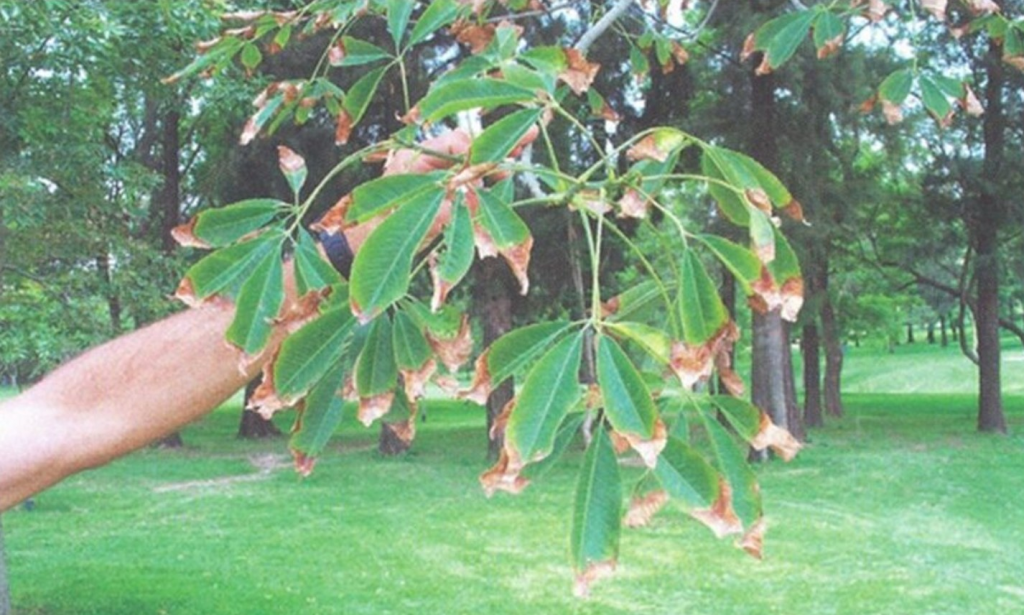
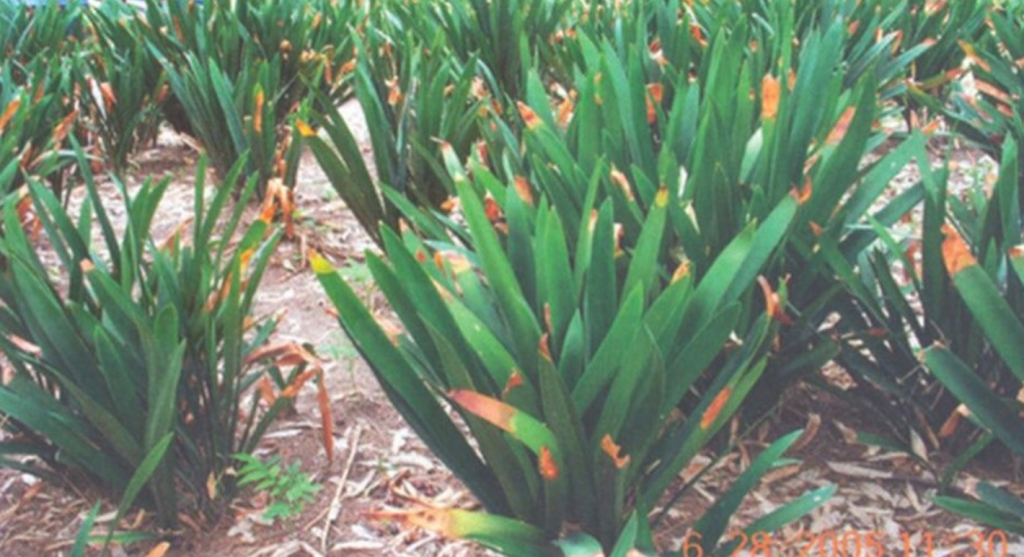
Salt burn doesn’t look like typical drought stress. While a thirsty tree wilts, a salt-stressed tree “scorches.”
- Marginal Necrosis: The most common symptom is a dry, brown, or “burnt” appearance along the outermost edges of the leaves.³
- Premature Leaf Drop: In severe cases, the tree will shed its foliage mid-summer as a desperate defense mechanism to rid itself of the accumulated toxins.
- Stunted New Growth: You may notice that new spring growth is significantly smaller, off-color, or “hooked” at the tips.⁴
3. Management Strategies: The “Leaching Fraction”
If your property is mandated to use reclaimed water, you cannot simply “turn it off.” You must instead manage the salt accumulation through a strategy of dilution and displacement.
- The Leaching Fraction: This involves applying a specific “extra” amount of water (usually 10–15% beyond what the plant needs) to physically push the accumulated salts down below the active root zone. This requires a sophisticated “Cycle & Soak” approach to ensure the water actually moves through the soil rather than running off.
- Gypsum Applications: On heavy clay soils, applying calcium sulfate (gypsum) can help displace sodium from soil particles, allowing it to be washed away during the leaching cycle.⁵
- Species Selection: If you are renovating a landscape on reclaimed water, you must prioritize salt-tolerant species. Our native Coast Live Oak has moderate tolerance, but sensitive species like Redwoods or Japanese Maples will rarely survive long-term on municipal recycled sources.
4. The Consultant’s Verdict: Monitoring Over Guesswork
I frequently see HOAs spending thousands on replacement plantings without ever testing the water that killed the previous ones. A professional management plan for reclaimed water requires annual soil and water testing to monitor the Sodium Adsorption Ratio (SAR) and Electrical Conductivity (EC). Without this data, you are simply “watering in” the next failure.
Professional References
1 Tanji, Kenneth K. and Wallender, Wesley W., Agricultural Salinity Assessment and Management, 2nd Edition, American Society of Civil Engineers, Page 412.
2 Costello, Laurence R., Abiotic Disorders of Landscape Plants: A Diagnostic Guide, University of California Agriculture and Natural Resources, Page 85.
3 Harris, Richard W., Arboriculture: Integrated Management of Landscape Trees, Shrubs, and Vines, 4th Edition, Prentice Hall, Page 210.
4 Brady, Nyle C. and Weil, Ray R., The Nature and Properties of Soils, 14th Edition, Pearson Education, Page 354.
5 Shigo, Alex L., A New Tree Biology, Shigo and Trees, Associates, Page 312.
Need a Professional 2nd Opinion?
The information above is a general guide, but salt management is a high-stakes technical challenge that varies wildly based on your specific municipal source and soil chemistry. Mistakes in managing reclaimed water can lead to the “silent” death of mature trees that take decades to replace.
At ArborSolutions, we provide the data and technical oversight you need to manage recycled water safely. We do not sell soil amendments, irrigation hardware, or replacement trees—we provide the unbiased professional advice you need to protect your property’s high-value assets with confidence.
Is your landscape showing signs of salt stress or municipal water burn? Book a Walking-Talking Tour for a site-specific diagnostic and a clear, science-based path forward.