
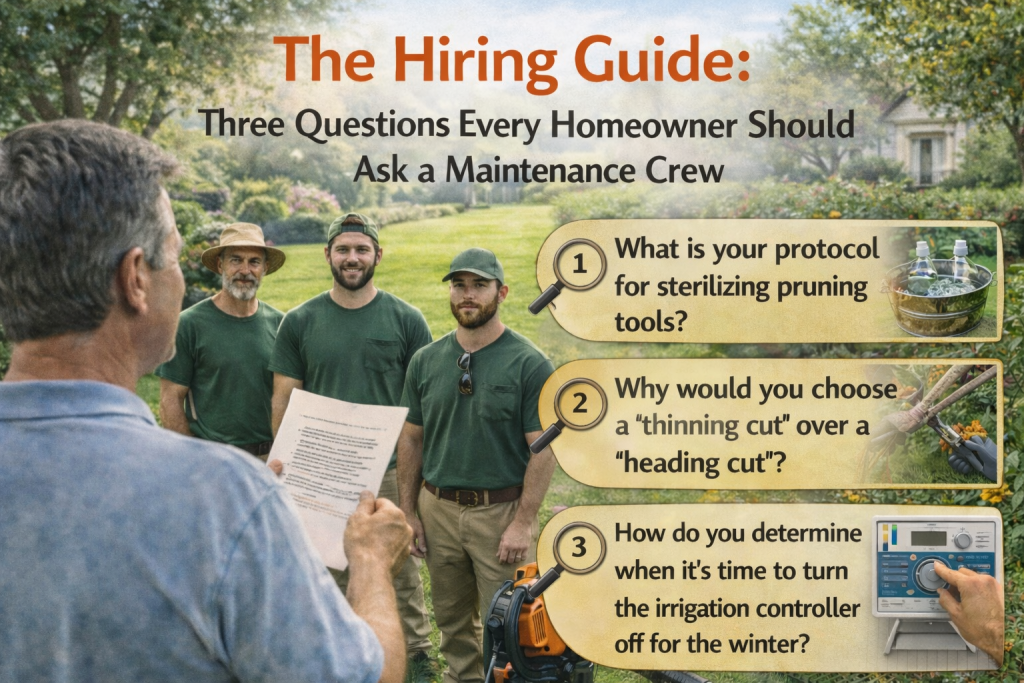
The Hiring Guide: Three Questions Every Homeowner Should Ask a Maintenance Crew
On the Central Coast, there is a significant difference between a “gardener” and a “landscape steward.” While many crews in Santa Barbara and San Luis Obispo are excellent at keeping a lawn mowed and the driveway blown clear, few are trained in the biological needs of high-value trees and woody shrubs.
As an independent consultant, I often see property owners hire based on the lowest bid, only to spend ten times that amount later to fix “mutilated” trees or replace suffocated shrubs. To protect your investment, you must shift from being a passive customer to an active manager. Before you sign a contract, ask these three technical questions to see if the crew understands the science of your landscape.¹
1. “What is your specific protocol for sterilizing pruning tools between different trees?”
This is the single most important question for preventing a biological catastrophe on your property. Pathogens like Fusarium Wilt and Fire Blight are “hitchhikers” that move from tree to tree on contaminated saw blades and shears.²
- The Wrong Answer: “We sharpen them every morning,” or “They look clean to me.”
- The Right Answer: “We use a 70% Isopropyl Alcohol spray or a 10% bleach solution on all blades before moving from one specimen to the next.”
- The Consultant’s Tip: Watch them work for ten minutes. If they move from a palm tree to an oak tree without pulling out a spray bottle, they are putting your assets at risk.
2. “Can you explain why you would choose a ‘thinning cut’ over a ‘heading cut’ for my shrubs?”
This question determines if the crew understands the long-term structure of your plants or if they are simply trapped in the “Mow & Blow” cycle of shearing everything into a geometric ball.³
- The Wrong Answer: “We just round them over so they look neat,” or “This is how we always do it.”
- The Right Answer: “We use selective thinning to reach into the canopy and remove branches at the point of origin. This allows sunlight and air into the interior, preventing hollow, woody centers and reducing the need for frequent shearing.”
- The Consultant’s Tip: A crew that only owns hedge shears and no hand-pruners is not equipped to maintain the structural health of your shrubs.
3. “How do you determine when it’s time to turn the irrigation controller off for the winter?”
Many maintenance contracts are set to “autopilot.” In our Mediterranean climate, the most common cause of tree failure is over-watering during our wet winter months, which leads to root rot and anaerobic soil conditions.⁴
- The Wrong Answer: “We leave it on the ‘Smart’ setting all year,” or “The grass needs it.”
- The Right Answer: “We perform a manual audit of the soil moisture at a 6-inch depth. Once the winter rains start and the trees enter dormancy, we turn the system to ‘Manual-Off’ unless we hit a specific 30-day dry spell.”
- The Consultant’s Tip: If your crew is watering your Coast Live Oaks during a January rainstorm, they are literally drowning your investment.
The Consultant’s Verdict: Specs Over Promises
I frequently tell my clients: “You get what you inspect, not what you expect.” A maintenance crew will almost always take the path of least resistance unless they are given a specific Scope of Work (SOW).
As your independent consultant, my role is to write those technical specifications for you. I provide the “ArborSolutions Standard” that your crew must follow, and I perform the site audits to ensure they are meeting those marks. We ensure that the people you hire are actually building your property’s value, not just raking the surface.⁵
Professional References
1 Harris, Richard W., Arboriculture: Integrated Management of Landscape Trees, Shrubs, and Vines, 4th Edition, Prentice Hall, Page 512.
2 Shigo, Alex L., Modern Arboriculture, Shigo and Trees, Associates, Page 174.
3 Gilman, Edward F., An Illustrated Guide to Pruning, 3rd Edition, Delmar Cengage Learning, Page 210.
4 Watson, Gary W., The Root System of Landscape Trees, International Society of Arboriculture, Page 156.
5 Costello, Laurence R., Training Young Trees for Structure and Form, University of California Agriculture and Natural Resources, Page 42.
Need a Professional 2nd Opinion?
Are you hiring a “mower” or a “manager”? At ArborSolutions, we provide the technical oversight and hiring guidance you need to protect your landscape from substandard care. We do not provide maintenance services ourselves—we act as your neutral advocate to ensure your contractors are delivering the high-level care your trees deserve.
Ready to upgrade your property’s management plan? Book a Walking-Talking Tour for a site-specific maintenance audit and a clear, science-based path forward.