
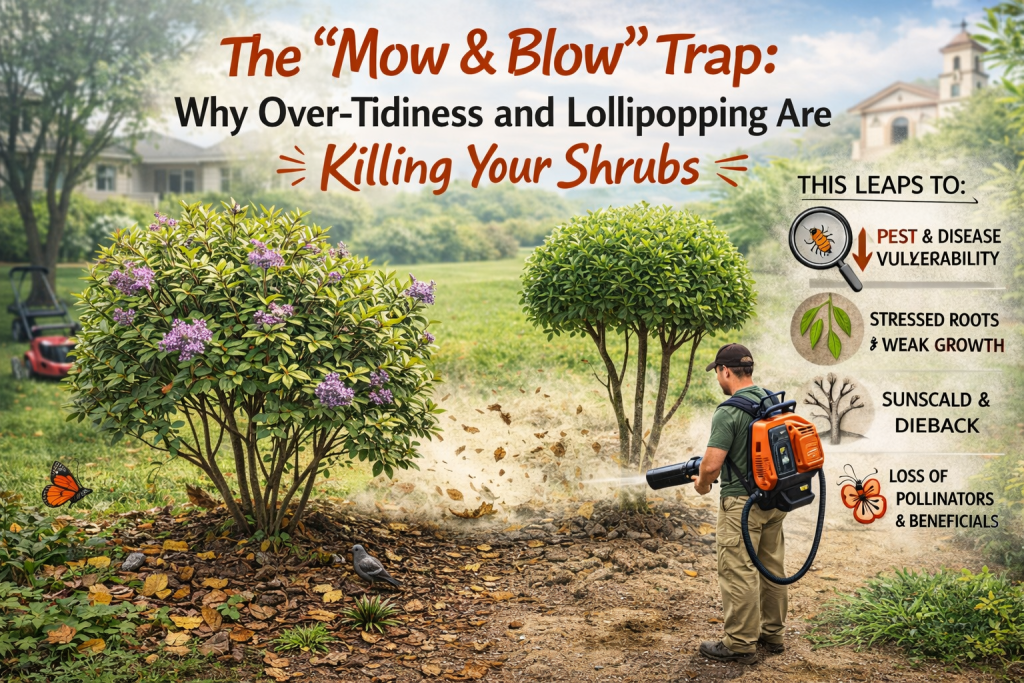
The “Mow & Blow” Trap: Why Over-Tidiness and Lollipoping Are Killing Your Shrubs
In the manicured landscapes of Santa Barbara, Santa Ynez, Arroyo Grande and San Luis Obispo areas, there is a pervasive style of maintenance often referred to as the “Mow & Blow” approach. To the untrained eye, the result looks orderly: shrubs are sheared into tight, geometric balls (lollipops) or boxes, and every fallen leaf is scoured from the soil with a high-powered blower.
As an independent consultant, I view this level of “over-tidiness” as a direct assault on the biological health of your landscape. What looks “clean” in the short term is actually a recipe for chronic plant stress, increased pest vulnerability, and premature failure.¹
1. The Physiology of the “Lollipop”
Shearing a shrub into a tight geometric shape is not pruning—it is a repetitive wounding process. When you use hedge shears to cut every branch tip to a uniform plane, you trigger a specific hormonal response called “apical dominance release.”
- The Outer Shell: The shrub responds by pushing out a thick, dense “shell” of new growth at the exterior. This looks green for a few weeks, but it creates a dark, airless environment in the interior of the plant.²
- Internal Dieback: Because sunlight cannot penetrate this outer shell, the inner leaves and branches die off. This is why “lollipopped” shrubs eventually become hollow, woody skeletons with only a thin veneer of green on top.
- The Energy Drain: Every time the shrub is sheared, it must use its stored energy to produce new leaves. Over time, this constant “re-leafing” exhausts the plant’s carbohydrate reserves, leading to a slow decline.
2. The Leaf Blower vs. Soil Health
The “Blow” half of the equation is equally damaging. High-velocity air (often exceeding 150 mph) does more than just move leaves; it strips the landscape of its “operating system.”
- Destroying the Duff Layer: In nature, fallen leaves decompose to create a “duff” layer that feeds beneficial fungi and bacteria. Blowing this away leaves the soil bare and sterile.
- Compaction and Erosion: Continuous blowing removes the fine particles of organic matter and topsoil, leaving behind a hard-packed surface that repels water (hydrophobicity).³
- Root Desiccation: The sheer force of the air can actually dry out the fine feeder roots that live just below the soil surface, leading to “invisible” drought stress even if your irrigation is running.
3. The “Shearing” Pest Loop
When a shrub is stressed by constant shearing, it becomes a magnet for pests. On the Central Coast, we frequently see an explosion of Scale, Aphids, and Whiteflies in lollipopped hedges.
- Poor Airflow: The dense outer shell traps humidity and prevents airflow, creating a perfect incubator for fungal pathogens like Powdery Mildew.⁴
- Chemical Lures: Stressed plants release chemical signals (volatiles) that tell insects, “I am weak.” This leads to a cycle of heavy pesticide use to save a plant that is only sick because of how it is being maintained.
4. The Consultant’s Verdict: Selective Thinning
The alternative to the Mow & Blow trap is Selective Thinning. Instead of shearing the entire surface, a professional maintenance plan involves reaching into the shrub and removing specific branches at their point of origin.
- Light and Air: Thinning allows sunlight to reach the interior, keeping the plant green all the way to the center.
- Natural Form: It preserves the elegant, natural “habit” of the plant, which is much more resilient to our local wind and heat.
- Reduced Costs: A thinned shrub only needs attention 2–3 times a year, whereas a sheared shrub requires “shaving” every 3 to 4 weeks.⁵
Professional References
1 Harris, Richard W., Arboriculture: Integrated Management of Landscape Trees, Shrubs, and Vines, 4th Edition, Prentice Hall, Page 356.
2 Shigo, Alex L., Modern Arboriculture, Shigo and Trees, Associates, Page 162.
3 Craul, Phillip J., Urban Soils: Applications and Practices, John Wiley & Sons, Page 218.
4 Costello, Laurence R., Abiotic Disorders of Landscape Plants: A Diagnostic Guide, University of California Agriculture and Natural Resources, Page 132.
5 Gilman, Edward F., An Illustrated Guide to Pruning, 3rd Edition, Delmar Cengage Learning, Page 210.
Need a Professional 2nd Opinion?
Is your landscape being maintained or is it being slowly “groomed” to death? At ArborSolutions, we provide the technical specifications and training oversight your maintenance crew needs to move away from the “Mow & Blow” model.
We do not provide gardening services. We provide unbiased professional advice and neutral advocacy to ensure your high-value shrubs and trees are managed for longevity, not just “tidiness.”
Are your hedges looking woody and hollow? Book a Walking-Talking Tour for a site-specific maintenance audit and a clear, science-based path forward.