“Limbing Up”: The Right Way vs. The Wrong Way
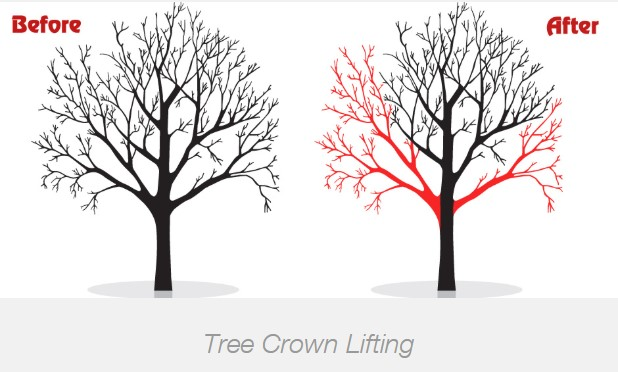
“Limbing up” or “Crown Raising”—the removal of lower branches—is the most common fuel reduction technique. However, it is often performed too aggressively, leading to a condition called “Lions-Tailing.”
- The 1/3rd Rule: You should never remove so many lower branches that the remaining canopy makes up less than two-thirds of the tree’s total height. A tree that has been “limbed up” too high becomes top-heavy and is prone to snapping in high winds.³
- Height Requirements: Most local fire ordinances require a clearance of 6 to 10 feet from the ground to the lowest branch. For smaller, younger trees, you may only be able to prune up a few feet to avoid over-stressing the plant.
- The Bark Factor: When you remove lower branches, you expose the trunk to direct sunlight. On the Central Coast, this can lead to sunscald, which kills the cambium layer and invites wood-boring beetles.⁴
3. Horizontal Separation: Breaking the Path
In addition to vertical clearance, we must look at how close trees and shrubs are to one another.
- The 100-Foot Zone: Within 30 to 100 feet of your home (Zone 2), the goal is to create “islands” of vegetation. By creating a 10-foot gap between the canopies of different trees, you prevent fire from jumping from one tree to the next.
- Slope Adjustment: Fire moves faster uphill. If your property is on a slope, the required horizontal spacing between your trees needs to increase. On a 20% slope, for example, you may need 20 feet of clearance between tree canopies.⁵
4. The Consultant’s Verdict: Selective Management
I frequently see “clear-cutting” performed in the name of fire safety. This is a mistake. Bare, scorched earth is a magnet for highly flammable invasive weeds like Mustard and Thistle, which grow back faster and thicker than the native plants you removed.
A professional Fire-Safe Audit focuses on selective removal. We identify the “high-risk” individuals—deadwood, diseased specimens, and volatile species like Eucalyptus or Pine—while preserving the healthy, fire-resistant native Oaks that provide shade and keep soil temperatures down.
Fire safety is about engineering the air space, not just removing the green.
Professional References
1 Harris, Richard W., Arboriculture: Integrated Management of Landscape Trees, Shrubs, and Vines, 4th Edition, Prentice Hall, Page 456.
2 CalFire, General Guidelines for Creating Defensible Space, State of California, Page 12.
3 Gilman, Edward F., An Illustrated Guide to Pruning, 3rd Edition, Delmar Cengage Learning, Page 182.
4 Shigo, Alex L., Modern Arboriculture, Shigo and Trees, Associates, Page 224.
5 Costello, Laurence R., Abiotic Disorders of Landscape Plants: A Diagnostic Guide, University of California Agriculture and Natural Resources, Page 144.
Need a Professional 2nd Opinion?
Is your “fuel reduction” protecting your home or destroying your trees? At ArborSolutions, we provide the technical oversight and specifications you need to achieve compliance without sacrificing your property’s high-value assets.
We do not perform brush clearing or tree removal. We provide unbiased professional advice to ensure your defensible space is science-based and effective.
Are you unsure if your property meets the latest county fire ordinances? Book a Walking-Talking Tour for a site-specific fire-safe assessment and a clear, prioritized path forward.