
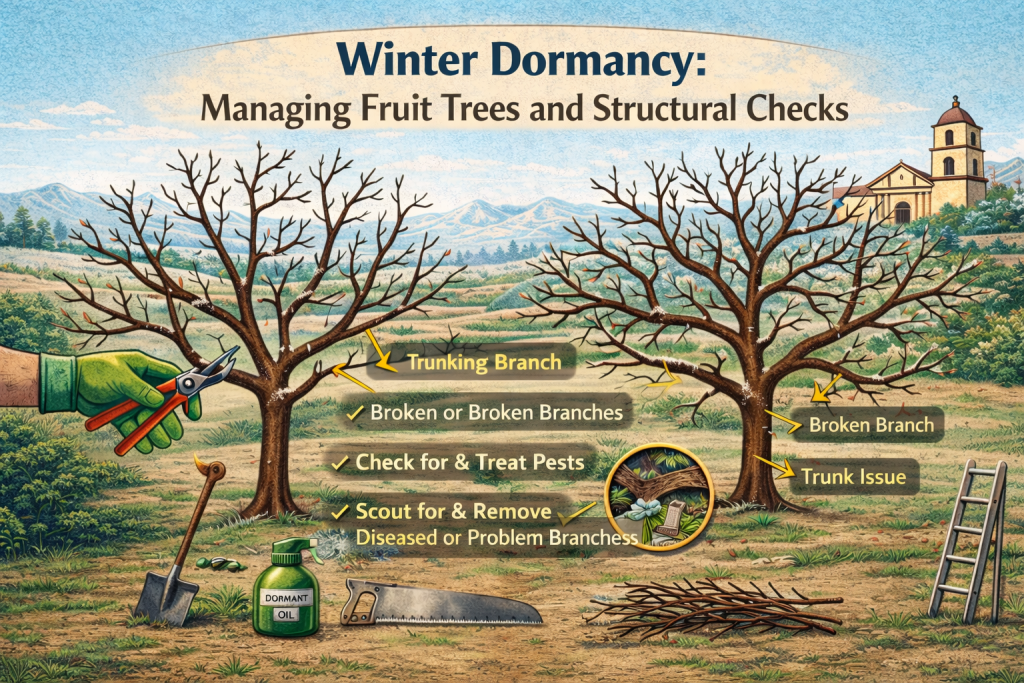
Winter Dormancy: Managing Fruit Trees and Structural Checks
On the Central Coast, winter dormancy is the “quiet season” for our trees, but it is the busiest season for a proactive property owner. In Santa Maria, San Luis Obispo, and the Santa Ynez Valley, the window between December and February—when deciduous trees have shed their leaves—is a unique opportunity to perform the structural “surgery” and diagnostics that are impossible to do when the canopy is full.¹
As an independent consultant, I view winter dormancy as the time to audit your “botanical hardware.” Whether you are managing a backyard orchard or a historic Sycamore, the bare canopy reveals the hidden defects and growth patterns that dictate the tree’s health for the rest of the year.
1. The X-Ray Effect: Structural Audits
When a tree drops its leaves, it effectively gives us an “X-ray” of its skeletal structure. This is the only time we can clearly see the branch architecture without the visual “noise” of foliage.
- Identifying Codominant Stems: This is the best time to spot “V-shaped” unions where two trunks are competing for dominance. These are prime failure points during our spring windstorms.²
- Locating Included Bark: We can now see where bark is being pinched between two branches, a clear sign of weak attachment that requires Subordination Pruning to prevent a split.
- Detecting Hidden Decay: Cavities, fungal brackets, and “bleeding” wounds on the trunk are much easier to identify and map when the canopy is bare.
2. Fruit Tree Management: Setting the Stage for Harvest
For Central Coast homeowners with stone fruits (Peaches, Plums, Apricots) or Apples, winter is the make-or-break season for fruit quality.
- Sanitation Pruning: Removing the “Three Ds”—Dead, Damaged, and Diseased wood—is critical for preventing the spread of fungal pathogens like Brown Rot or Fire Blight during our wet winter months.³
- Light Penetration: By thinning the inner canopy now, we ensure that sunlight can reach the center of the tree in June. This “inner light” is what triggers the development of fruiting spurs and improves the sugar content (Brix) of your fruit.
- Dormant Sprays: This is the window to apply organic horticultural oils or copper-based sprays. These “dormant” applications kill overwintering pests like Scale and Aphid eggs before they hatch in the spring, reducing the need for heavy pesticides in the summer.⁴
3. Deciduous Maintenance: The “Low Stress” Window
Pruning a tree while it is dormant is far less stressful for the plant than pruning it in mid-summer.
- Food Reserves: During the winter, the tree’s energy (starches) is stored safely in the roots and trunk. Removing a branch now doesn’t remove the tree’s food source; it simply redirects that stored energy to the remaining buds when spring arrives.⁵
- Sealing Potential: While the tree isn’t actively growing, it is primed and ready. As soon as the soil warms up in March, the tree will immediately begin forming a callus roll to seal the winter cuts.
4. The Consultant’s Verdict: Mapping the Future
I frequently see “mow-and-blow” crews ignore dormant trees because “there’s nothing to rake.” This is a missed opportunity. A professional Winter Structural Audit allows us to create a multi-year management plan. We can decide today which branches need to be removed in 2027 to prevent a failure in 2030.
By the time the first leaves appear in March, the window for major structural correction has closed. Proactive management happens while the tree is asleep.
Professional References
1 Harris, Richard W., Arboriculture: Integrated Management of Landscape Trees, Shrubs, and Vines, 4th Edition, Prentice Hall, Page 282.
2 Gilman, Edward F., An Illustrated Guide to Pruning, 3rd Edition, Delmar Cengage Learning, Page 156.
3 Shigo, Alex L., Modern Arboriculture, Shigo and Trees, Associates, Page 112.
4 Watson, Gary W., The Root System of Landscape Trees, International Society of Arboriculture, Page 148.
5 Costello, Laurence R., Training Young Trees for Structure and Form, University of California Agriculture and Natural Resources, Page 34.
Need a Professional 2nd Opinion?
Is your maintenance crew waiting for the leaves to fall to stop working, or are they using the “bare canopy” window to protect your assets? At ArborSolutions, we provide the technical oversight and structural specifications you need to manage your trees with precision.
We do not perform pruning or spray applications. We provide unbiased professional advice to ensure that your winter maintenance is backed by science, not just habit.
Are your dormant trees hiding structural defects? Book a Walking-Talking Tour for a site-specific winter audit and a clear, science-based path forward.