
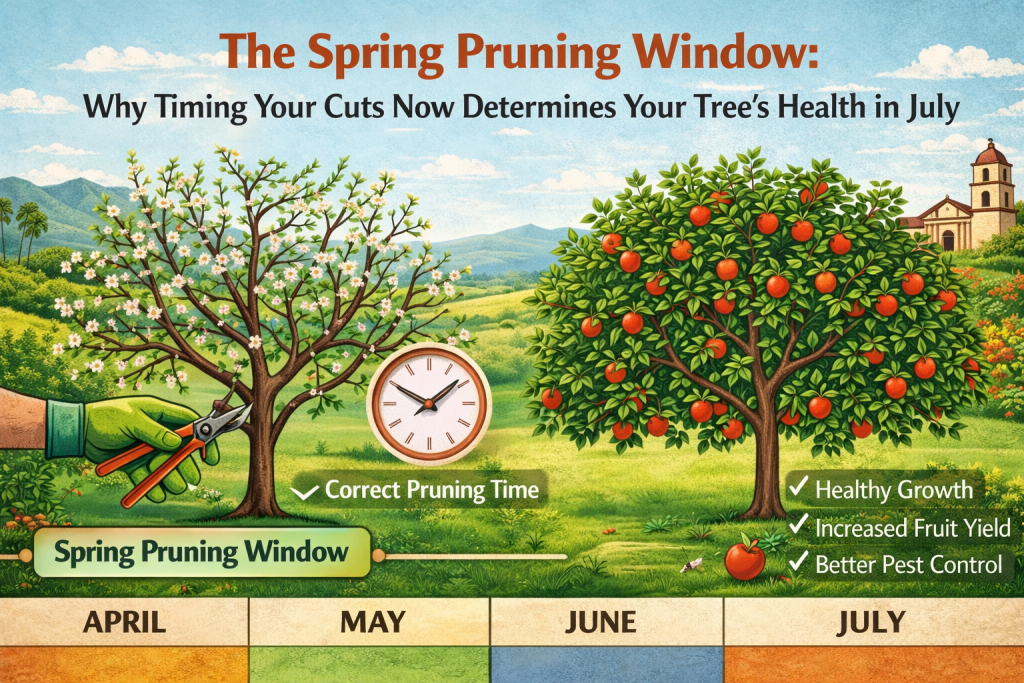
The Spring Pruning Window: Why Timing Your Cuts Now Determines Your Tree’s Health in July
On the California Central Coast, there is a brief but critical period in early spring when the “biological engine” of your trees begins to rev up. As soil temperatures in Santa Maria and Santa Barbara rise, trees shift from winter dormancy into a high-energy phase of sap flow and bud break.
As an independent consultant, I frequently see property owners wait until the heat of July to address “overgrown” canopies. This is a strategic error. Pruning during the Spring Window allows a tree to utilize its peak energy reserves to seal wounds and adjust its structure before the punishing drought stress of summer arrives.¹
1. The Energy Budget: Why Timing Matters
Trees operate on a strict carbon budget. During the spring “flush,” a tree invests a massive amount of its stored energy into producing new leaves.
- The Summer Trap: If you wait until July to prune, you are removing leaves that the tree has already spent its energy to build. By mid-summer, the tree is already entering “survival mode” due to heat and low moisture. Removing 20% of the canopy in July is a double-hit to the tree’s energy reserves.²
- The Spring Advantage: Pruning in the early spring window—just as buds are swelling but before full leaf-out—allows the tree to redirect its “spring surge” of energy toward the remaining branches. This results in stronger, more resilient growth by the time the Santa Ana winds arrive in the fall.
2. Codit: The Science of Sealing
One of the most important reasons to prune in the spring is CODIT (Compartmentalization of Decay in Trees). Unlike humans, trees do not “heal” wounds; they “seal” them by growing specialized wood over the cut.³
- Rapid Callus Growth: In the spring, the cambium (the growing layer of the tree) is at its most active. A proper pruning cut made in March or April will begin forming a “callus roll” almost immediately.
- Fungal Defense: By sealing the wound quickly during the spring growth surge, the tree effectively “walls off” the area before wood-decay fungi or wood-boring insects become active in the heat of summer.⁴
3. Pest Prevention: Avoiding the “Dinner Bell”
Certain pests on the Central Coast are chemically “tuned” to the smell of fresh pruning cuts. Timing your pruning helps you avoid these infestation windows.
- Bark Beetles: Many species of bark beetles are most active during the hottest months. A fresh pruning cut in July acts like a “dinner bell,” drawing beetles to a tree that is already stressed by the heat.
- Fire Blight: For species in the Rose family (like Pears and Apples), pruning during the late spring rains can spread bacterial diseases. The “Spring Window” is the sweet spot—after the heaviest rains have passed but before the peak insect activity begins.⁵
4. The Consultant’s Verdict: Proactive vs. Reactive
I frequently see “mow-and-blow” crews performing “reactive pruning”—cutting only when a branch is hitting a roof or hanging over a driveway. A professional Spring Pruning Specification is proactive. We look at the tree’s structure today to determine how it will handle the weight of a full summer canopy and the stress of a 95°F day in July.
Pruning now isn’t just about aesthetics; it is about ensuring the tree has the biological “checks and balances” in place to survive the toughest months of the Central Coast year.
Professional References
1 Harris, Richard W., Arboriculture: Integrated Management of Landscape Trees, Shrubs, and Vines, 4th Edition, Prentice Hall, Page 322.
2 Shigo, Alex L., A New Tree Biology, Shigo and Trees, Associates, Page 210.
3 Shigo, Alex L., Modern Arboriculture, Shigo and Trees, Associates, Page 44.
4 Gilman, Edward F., An Illustrated Guide to Pruning, 3rd Edition, Delmar Cengage Learning, Page 12.
5 Watson, Gary W., The Root System of Landscape Trees, International Society of Arboriculture, Page 168.
Need a Professional 2nd Opinion?
Is your maintenance crew pruning for the “now” or for the future? At ArborSolutions, we provide the technical specifications you need to ensure your trees are pruned at the right time and in the right way. We do not perform the pruning ourselves—we act as your neutral advocate to ensure your landscape assets are protected from poorly timed or excessive cutting.
Don’t wait until your trees are stressed in July to take action. Book a Walking-Talking Tour for a site-specific spring assessment and a clear, science-based pruning plan.
Request a Walking-Talking Tour at ArborSolutions.pro