
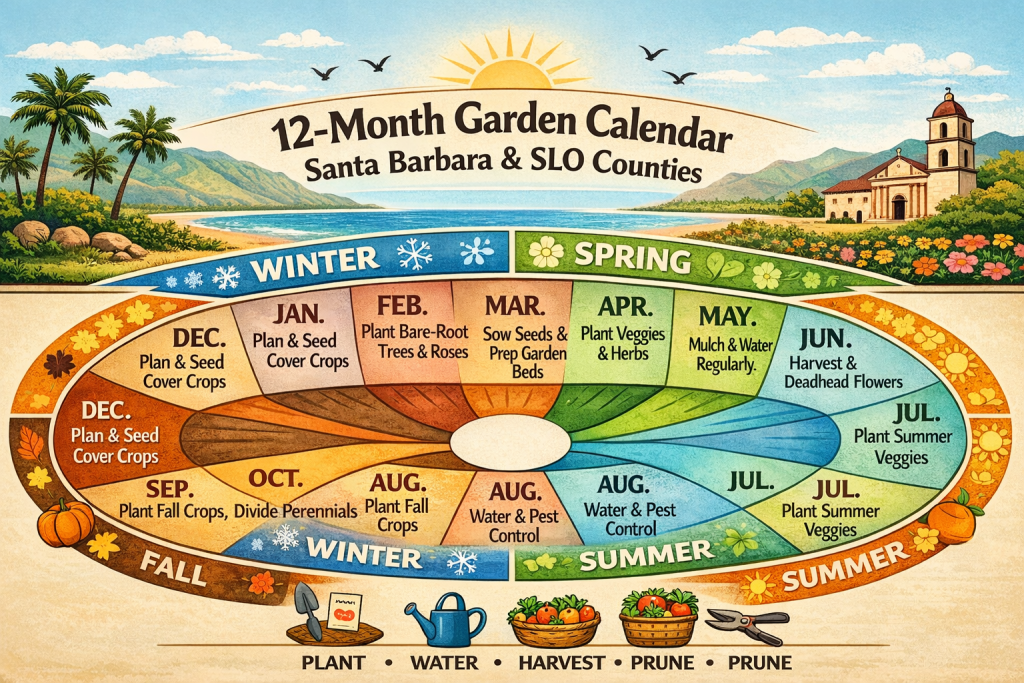
12-Month Tree and Landscape Care Calendar for Santa Barbara and San Luis Obispo Counties
A regional roadmap for smarter pruning, planting, inspections, and seasonal stewardship on California’s Central Coast
If you manage a property in Santa Barbara County or San Luis Obispo County, your tree and landscape care schedule should follow the Central Coast’s wet-winter, dry-summer pattern—not a generic national gardening calendar. This 12-month guide explains the best seasonal timing for pruning, planting, inspections, mulching, pest monitoring, and irrigation changes based on local conditions.
On California’s Central Coast, timing matters. Prune too early, irrigate too long, miss the planting window, or overlook summer stress signals, and the result can be wasted water, unnecessary decline, and expensive corrective work later. A property-specific plan is always best, but this regional calendar gives homeowners, HOAs, and property managers a practical framework for year-round stewardship.
Quick Seasonal Summary for Santa Barbara and San Luis Obispo County Properties
- December–February: Reduce or shut off most irrigation, prune suitable dormant deciduous trees, apply mulch, and take advantage of winter soil moisture.
- March–May: Control weeds, inspect irrigation systems, monitor new growth, and watch for early pest and disease activity.
- June–August: Deep water strategically, reduce fire fuel, protect young trees, and monitor heat and drought stress.
- September–November: Assess summer damage, inspect trees before storm season, and begin fall planting while soil is cooling and moisture is returning.
What Makes a Central Coast Tree and Landscape Calendar Different?
Santa Barbara County and San Luis Obispo County properties do not behave like landscapes in colder or wetter climates. Our region is shaped by Mediterranean weather: wetter winters followed by long, dry summers. Coastal influence, inland heat, wind exposure, clay soils, sandy soils, irrigation design, mature oak canopies, and local plant palettes all affect how and when a landscape should be managed.
That means the best tree and landscape calendar for the Central Coast is not based on a generic four-season template. It is based on local rainfall patterns, seasonal drought stress, pruning windows, pest timing, planting success, and the realities of managing landscapes in Santa Maria, Nipomo, Orcutt, Arroyo Grande, Lompoc, Santa Ynez, Buellton, Goleta, Santa Barbara, and nearby communities.
Phase 1: Wet Season Tree and Landscape Care (December–February)
Winter is the recovery season. Soil profiles begin to recharge, root zones regain moisture, and many trees benefit from lower stress levels. This is the time to let winter rains do the work wherever possible and to avoid unnecessary irrigation.
December: Turn the Irrigation Controller Down or Off
For many established landscapes on the Central Coast, December is the month to reduce or shut off most irrigation. Unless the season is unusually dry, the soil profile should be receiving enough natural moisture to support dormant or slower-growing plants. Continuing to irrigate automatically through winter is one of the most common management mistakes in Santa Barbara County and San Luis Obispo County landscapes.
January: Dormant Pruning Window
January is often the best time to prune many deciduous trees, including fruit trees and certain shade trees, while branch structure is easier to evaluate. This is a useful window for structural pruning, clearance decisions, and basic canopy correction on suitable species. It is not a blanket pruning month for every tree, but for the right trees, winter can be an excellent time to work.
February: Mulch and Soil Moisture Stewardship
Late winter is a strong time to apply arborist wood chips or other appropriate mulch around trees and planting areas. Mulch helps hold moisture, buffer soil temperatures, and suppress weeds before spring growth accelerates. Keep mulch away from trunks and root flares, and avoid the common “mulch volcano” mistake.
Phase 2: Spring Growth and Maintenance Priorities (March–May)
Spring is the high-energy season. Soil temperatures rise, shoot growth increases, weeds surge, pests wake up, and irrigation systems often come back online. This is when small mistakes can turn into larger summer problems.
March: Weed Pressure and Competition Control
Spring weeds are not just a cosmetic issue. In many Central Coast landscapes, weed growth competes with trees and ornamentals for surface moisture and nutrients. March is a smart month to get ahead of invasive weeds before seed production and before they build too much momentum.
April: Irrigation Inspection and Adjustment
Before warm weather arrives, inspect your irrigation system. Check for clogged emitters, broken spray heads, overspray hitting trunks, runoff, mismatched coverage, and inconsistent watering zones. This is one of the best months to catch inefficiencies before summer water demand rises.
May: Early Pest and Disease Monitoring
As new growth expands, watch for aphids, scale, mildew, galls, and other early-season issues. The earlier a problem is recognized, the more management options you usually have. This is especially important for oaks, coastal ornamentals, and high-value landscape areas where decline may stay hidden until summer stress exposes it.
Phase 3: Summer Water Stress and Fire-Season Priorities (June–August)
By June, the rain is gone. From this point forward, most Central Coast landscapes depend on stored soil moisture and supplemental irrigation. This is the season when weak root systems, poor watering practices, and neglected maintenance become visible.
June: Deep Watering and Root-Zone Strategy
Summer irrigation should be deep and deliberate, not shallow and frequent. The goal is to encourage deeper rooting and more resilient moisture use. Shallow irrigation often leads to surface rooting, poor stress tolerance, and wasted water. This is especially important in hotter inland areas of Santa Barbara County and San Luis Obispo County.
July: Fire Season and Defensible Space
July is a critical time to evaluate dry fuels, clearance, overgrown brush, and dead material—especially in foothill and inland locations. Fire-safe stewardship should be thoughtful, species-aware, and compatible with the health of valuable trees and landscape features. This is also the season to monitor heat stress, leaf scorch, and irrigation shortfalls.
August: Young Tree Support and Stress Monitoring
Young trees usually need the most attention in late summer. Their root systems are still developing, and they can decline quickly without targeted watering. August is also when drought stress, poor irrigation distribution, and site-related problems often become obvious. Wilting, canopy thinning, early leaf drop, and branch tip dieback should not be ignored.
Phase 4: Fall Inspection and Planting Season (September–November)
Fall is one of the most valuable seasons for property evaluation on the Central Coast. Summer stress has revealed weaknesses, storm season is approaching, and soil conditions are about to improve for planting and root establishment.
September: Stress Assessment
By September, you can often see which trees and plantings handled the summer well and which did not. Early leaf drop, canopy thinning, weak color, branch dieback, and heat damage are clues worth paying attention to. This is a good time to assess whether irrigation timing, soil conditions, planting choices, or maintenance practices need to change.
October: Pre-Storm Inspection Window
October is a smart month for structural inspections before winter storms begin. Look for dead limbs, cracked unions, weak attachments, hanging branches, root-zone disturbance, or previous pruning that created instability. This is especially important for properties with mature trees near homes, driveways, sidewalks, streets, or common areas.
November: Planting Season Begins
Fall planting is one of the strongest strategies for Central Coast landscapes. Cooler weather and improving soil moisture allow roots to establish before the following summer. November is often a better planting month than late spring because the plant has time to settle in before heat and drought pressure return.
Best Times for Pruning, Planting, Inspections, and Irrigation Changes
For many Central Coast properties, the most important seasonal timing points are:
- Winter: reduce irrigation, prune suitable dormant trees, mulch, and protect soil moisture
- Spring: inspect irrigation, control weeds, watch new growth, and catch pests early
- Summer: deep water strategically, protect young trees, monitor drought stress, and reduce fuel hazards
- Fall: assess summer damage, inspect trees before storms, and begin planting
The right schedule always depends on species, soil, age, exposure, irrigation type, slope, and site history. A mature Coast Live Oak, a newly planted fruit tree, and a managed HOA planting bed should not all be handled the same way.
Why a Generic Maintenance Schedule Often Fails
Many maintenance programs follow the same routine every month, whether the property needs it or not. That can lead to pruning at the wrong time, winter irrigation that should have been turned off, shallow summer watering, or planting choices that are poorly matched to local conditions.
The Central Coast rewards timing and observation. Smarter landscape management is not about doing more. It is about doing the right work at the right time.
Frequently Asked Questions
When should irrigation be turned off in winter on the Central Coast?
In many established landscapes, irrigation can be reduced significantly or shut off during the wet season, depending on rainfall, soil drainage, plant type, and site exposure. Controllers should not run on a summer schedule through winter by default.
When is the best time to prune trees in Santa Barbara County and San Luis Obispo County?
It depends on the species and the objective. Many deciduous trees are best evaluated and pruned during dormancy, while other species require different timing. Avoid assuming all pruning should happen at the same time of year.
Is fall the best time to plant on the Central Coast?
In many cases, yes. Fall gives roots a chance to establish in cooler, moister soil before the next dry season arrives.
When should I inspect trees before storm season?
Early to mid-fall is an excellent time to evaluate trees for deadwood, structural defects, weak attachments, and canopy issues before winter winds and rain increase loading.
Do young trees need a different summer watering schedule?
Yes. Young trees generally need more intentional support during summer because they have not yet developed a broad, resilient root system.
Is a calendar enough for every property?
No. A regional calendar is a strong starting point, but site conditions still matter. Soil type, microclimate, species, exposure, irrigation design, and maintenance history can all change the right recommendation.
Need a Site-Specific Tree and Landscape Management Plan?
A regional calendar is useful, but every property has its own conditions. What works in coastal Santa Barbara may not be right for inland Santa Maria, Nipomo, Orcutt, Arroyo Grande, or the Santa Ynez Valley.
At ArborSolutions, we provide independent guidance for homeowners, HOAs, and property managers who want more than a generic maintenance schedule. That includes site-specific observations, practical recommendations, and second-opinion support before costly pruning, removals, irrigation changes, or contractor decisions are made.
We do not sell tree trimming, removals, or irrigation hardware. We provide objective professional guidance designed to help you manage your property more intelligently and protect high-value trees and landscapes over time.
Request a Walking-Talking Tour at ArborSolutions.pro
Professional References
Costello, Lawrence R., Abiotic Disorders of Landscape Plants: A Diagnostic Guide.
Harris, Richard W., Arboriculture: Integrated Management of Landscape Trees, Shrubs, and Vines.
Gilman, Edward F., An Illustrated Guide to Pruning.
Shigo, Alex L., Modern Arboriculture.
Watson, Gary W., The Root System of Landscape Trees.