
Mycorrhizae: Restoring the “Underground Internet”
On the Central Coast, our iconic Coast Live Oaks and Toyons don’t grow in isolation. Beneath the surface, they are plugged into a vast, microscopic network of beneficial fungi known as Mycorrhizae. This isn’t just a biological “extra”—it is the fundamental life-support system that allows our native plants to survive seven months of zero rainfall.¹
As an independent consultant, I view Mycorrhizae as the “Digital Infrastructure” of your soil. Without it, your trees are forced to rely on expensive, artificial irrigation and fertilizers that often do more harm than good. Understanding how to restore and protect this network is the key to a truly resilient landscape.
1. The Symbiotic Exchange: Water for Sugar
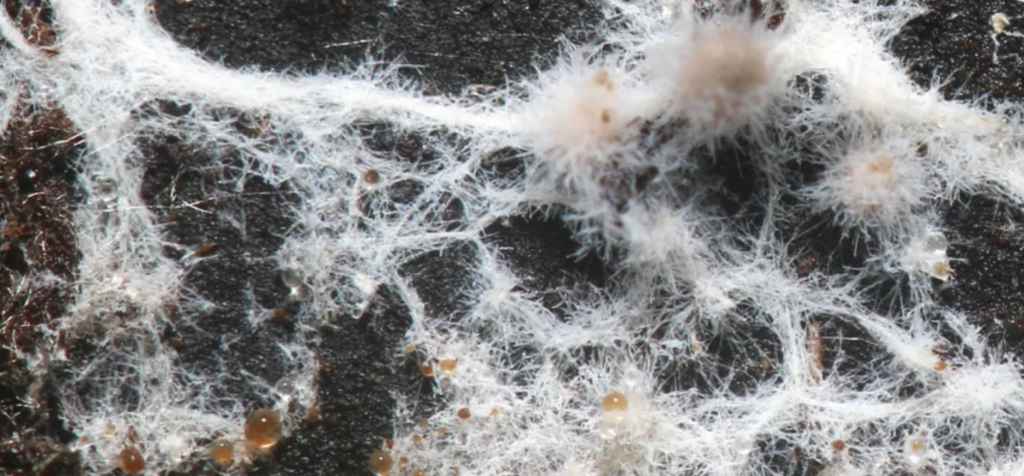
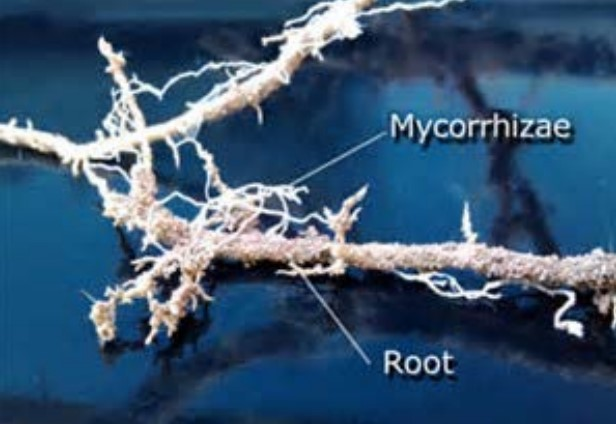
The word “Mycorrhizae” literally means “Fungus-Root.” These specialized fungi attach themselves to tree roots and extend their own thread-like structures, called hyphae, far into the surrounding soil.
- The Tree’s Contribution: The tree provides the fungi with surplus sugars (glucose) produced through photosynthesis in the leaves.
- The Fungi’s Contribution: In exchange, the fungi act as a massive extension of the root system. Their hyphae are much finer than root hairs, allowing them to reach into tiny soil pores to pull out moisture and phosphorus that the tree simply couldn’t access on its own.²
2. The Communication Network: “The Wood-Wide Web”
Mycorrhizal networks don’t just connect one tree to the soil; they can connect multiple trees to each other. This creates a “resource-sharing” economy within a landscape.
- Nutrient Shuttling: Established “Mother Trees” can actually shuttle nutrients through the fungal network to younger saplings struggling in the shade.³
- Chemical Signaling: When a tree is attacked by pests, it can send chemical “warning signals” through the mycelium to neighboring trees, allowing them to preemptively increase their own chemical defenses before the insects arrive.⁴
3. The Modern Threat: Breaking the Connection
The biggest threat to this fungal internet is modern “mow-and-blow” maintenance. In my site audits across San Luis Obispo and Santa Barbara counties, I frequently find landscapes where the “underground internet” has been completely severed.
- Tillage and Grading: Physically breaking the soil profile rips the delicate hyphae apart.
- Synthetic Fertilizers: High-nitrogen, “quick-fix” salts can actually make the tree “lazy.” When a tree has an abundance of artificial nitrogen, it may stop feeding the fungi, causing the mycorrhizal colony to starve and die.
- Systemic Fungicides: While intended to kill “bad” fungi, many broad-spectrum fungicides also kill the “good” mycorrhizal partners.⁵
4. The Consultant’s Verdict: Biology First
I frequently see property owners spending thousands on “tree injections” when the problem is actually a dead soil profile. Restoring the mycorrhizal network requires a “Biology-First” approach:
- Stop the Salts: Transition away from high-salt synthetic fertilizers.
- The Mulch Buffer: Apply a 4-inch layer of Arborist Wood Chips to provide the organic carbon the fungi need to thrive.
- Inoculation (When Necessary): In heavily disturbed soils, we can manually re-introduce mycorrhizal spores to jump-start the system. However, inoculation only works if the soil environment is managed to keep the fungi alive.
Professional References
1 Brady, Nyle C. and Weil, Ray R., The Nature and Properties of Soils, 14th Edition, Pearson Education, Page 456.
2 Shigo, Alex L., A New Tree Biology, Shigo and Trees, Associates, Page 164.
3 Simard, Suzanne, Finding the Mother Tree: Discovering the Wisdom of the Forest, Knopf, Page 112.
4 Harris, Richard W., Arboriculture: Integrated Management of Landscape Trees, Shrubs, and Vines, 4th Edition, Prentice Hall, Page 152.
5 Watson, Gary W., The Root System of Landscape Trees, International Society of Arboriculture, Page 134.
Need a Professional 2nd Opinion?
Is your landscape a collection of isolated plants, or is it a thriving, connected ecosystem? At ArborSolutions, we provide the data and technical oversight you need to restore the “underground internet” of your property.
We do not sell fertilizers, inoculants, or mulch services. We provide unbiased professional advice and biological diagnostics to help you build a landscape that sustains itself.
Ready to plug your trees back into the network? Book a Walking-Talking Tour for a site-specific diagnostic and a clear, science-based path forward.