
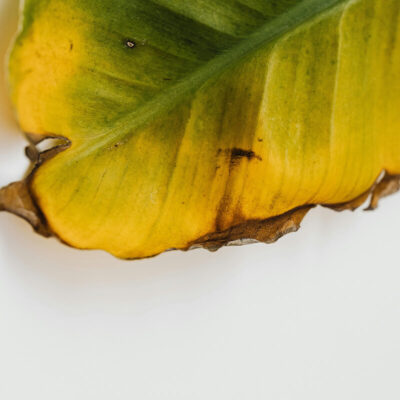
pH Balance: Why Your Leaves Are Turning Yellow
If your Coast Live Oak, Sycamore, or Liquidambar has leaves that are pale yellow with dark green veins, you aren’t just looking at a “hungry” tree. You are likely witnessing Interveinal Chlorosis. Many property owners and maintenance crews assume this is a simple nitrogen deficiency and respond by adding more fertilizer, but the true culprit is often the “Master Switch” of soil: **pH.**¹
On the Central Coast, particularly in the newer developments of Santa Maria, San Luis Obispo, and Paso Robles, our soils lean toward alkaline (high pH). When the pH is too high, it doesn’t matter how much fertilizer you throw at the ground; the nutrients are chemically “locked” away from the tree.
1. The “Lock-and-Key” Mechanism
Soil pH is a measure of the acidity or alkalinity of the soil on a scale of 0 to 14. Most landscape trees thrive in a slightly acidic to neutral range (6.0 to 7.0). In this “sweet spot,” nutrients like iron, manganese, and zinc are soluble and easily absorbed by root hairs.²
- The Alkaline Trap: When the pH climbs above 7.5—common in areas with limestone-heavy geology or concrete construction debris—essential micronutrients undergo a chemical change. They bind tightly to soil particles, becoming insoluble.
- The Result: The nutrients are physically present in the dirt, but the tree is “starving in the midst of plenty” because it cannot break the chemical bond to pull them in.³
2. The Concrete Connection
In the urban environments of the Central Coast, high pH is often an artificial problem. I frequently find that trees planted near sidewalks, foundations, or large driveways suffer the most.
- Leaching Lime: As concrete weathers, it leaches calcium hydroxide (lime) into the surrounding soil. This creates a localized “alkaline zone” that can spike the pH well into the 8.0+ range.⁴
- Reclaimed Water: As discussed in our Irrigation Pillar, municipal recycled water often carries high levels of bicarbonates, which act as a constant “liquid lime” application, slowly driving up the soil pH over several seasons.
3. Why Fertilizing Isn’t the Fix
Applying standard high-nitrogen fertilizer to a tree suffering from pH-induced chlorosis is like giving a thirsty person a saltine cracker. It doesn’t solve the hydration issue; it just adds to the metabolic stress.
- Salt Accumulation: Many synthetic fertilizers are salts. In our already alkaline Central Coast soils, adding more salt can further inhibit water uptake and damage beneficial soil biology.
- The Sulfur Solution: To lower pH, we typically use elemental sulfur. However, this is not an instant fix. It requires soil microbes to convert the sulfur into sulfuric acid, a process that can take 6–12 months depending on soil temperature and moisture levels.⁵
4. The Consultant’s Verdict: Test Before You Treat
I have seen property owners spend thousands of dollars on “miracle” tree injections and soil drenches that failed because they never spent $100 on a professional lab test. A Soil Laboratory Analysis is the only way to determine your actual pH and the “buffering capacity” of your soil—which tells us how hard we have to work to move that pH needle.
My role is to interpret those lab results into a site-specific prescription that addresses the chemistry, not just the symptoms.
Professional References
1 Brady, Nyle C. and Weil, Ray R., The Nature and Properties of Soils, 14th Edition, Pearson Education, Page 312.
2 Harris, Richard W., Arboriculture: Integrated Management of Landscape Trees, Shrubs, and Vines, 4th Edition, Prentice Hall, Page 172.
3 Craul, Phillip J., Urban Soils: Applications and Practices, John Wiley & Sons, Page 128.
4 Shigo, Alex L., Modern Arboriculture, Shigo and Trees, Associates, Page 144.
5 Watson, Gary W., The Root System of Landscape Trees, International Society of Arboriculture, Page 98.
Need a Professional 2nd Opinion?
Yellow leaves are a distress signal, but the solution is rarely found in a bag of generic fertilizer. At ArborSolutions, we provide the data and technical oversight you need to manage your soil chemistry without the conflict of interest.
We do not sell fertilizers, sulfur, or soil amendments. We provide unbiased professional advice and lab-verified diagnostics to help you make confident decisions for your property’s long-term health.
Are your trees looking pale or stunted? Book a Walking-Talking Tour for a site-specific diagnostic and a clear, science-based path forward.