
Establishing New Trees: The 3-Year Weaning Process
One of the most common misconceptions I encounter on the Central Coast is that once a tree is in the ground, the job is done. In reality, the moment of planting is simply the beginning of a critical three-year physiological transition. During this window, the tree is essentially in “intensive care,” moving from the artificial support of a nursery container to the rugged reality of our local Santa Barbara and San Luis Obispo County soils.
As an independent consultant, I view this period as a weaning process. The goal is to strategically decrease the tree’s dependence on supplemental water while simultaneously encouraging a sprawling, resilient root architecture that can survive our next multi-year drought.
1. Year One: The “Intensive Care” Phase
In the first twelve months, the tree is suffering from Transplant Shock. It has lost a significant portion of its root mass during the transition from the nursery, and its primary focus is survival, not upward growth.
- Hydration Focus: In Year One, the root ball must remain consistently moist. Because the roots have not yet moved into the surrounding native soil, watering the native ground several feet away does nothing for the tree.
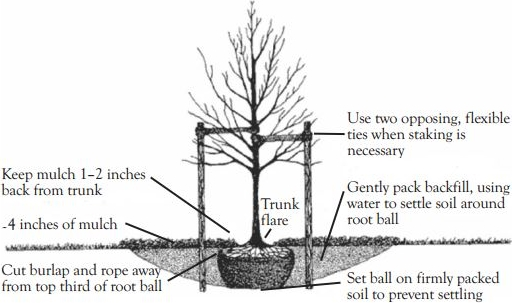
- The Placement Rule: Emitters should be placed directly over the root ball. In our heavy Central Coast clays, a “basin” or “berm” approach is often necessary to ensure water slowly percolates through the container mix rather than sheeting off the surface. 1
2. Year Two: Encouraging Exploration
By the second year, the tree should be initiating “pioneer roots” that venture out into the native soil. This is the year where we begin the first stage of weaning.
- Moving the Water: You must move your drip emitters or bubblers outward, away from the trunk. This creates a “moisture gradient” that lures the roots further into the landscape.
- Deepening the Cycle: Instead of frequent, light watering, you should increase the volume of water but decrease the frequency. This teaches the roots to seek moisture deeper in the soil profile, where it is protected from the evaporative heat of the afternoon sun. 2, 3
3. Year Three: Establishing Independence
Year three is the “make or break” year for long-term structural stability. By now, the root system should be roughly 1.5 to 2 times the width of the leaf canopy.
- The Weaning Trigger: During this final year, you should significantly extend the days between irrigation cycles. The goal is to “stress” the tree just enough to trigger its natural drought-response mechanisms without hitting a permanent wilting point.
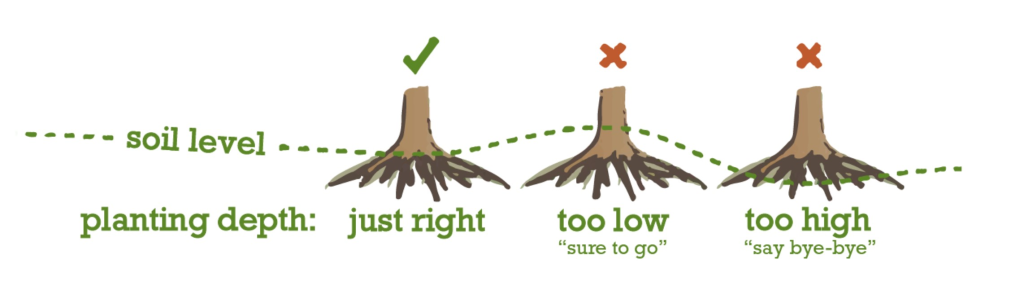
- Root Flare Drying: It is critical in Year Three to ensure the Root Flare (where the trunk meets the dirt) remains bone-dry. Keeping this area wet during the third year is the leading cause of crown rot in young Oaks and Sycamores. 3
4. The Consultant’s Verdict: Growth vs. Stability
I often see property owners push their young trees with excessive nitrogen fertilizer and daily water to get “instant privacy.” While this results in fast top-growth, it creates a “spoiled” tree with a weak, localized root system. When the first major winter storm hits our coast, these top-heavy trees are the first to fail. True stewardship means prioritizing root-to-shoot balance over rapid height. 4,5
Professional References
- Harris, Richard W., Arboriculture: Integrated Management of Landscape Trees, Shrubs, and Vines, 4th Edition, Prentice Hall, Page 322.
- Gilman, Edward F., An Illustrated Guide to Pruning, 3rd Edition, Delmar Cengage Learning, Page 118.
- Shigo, Alex L., A New Tree Biology, Shigo and Trees, Associates, Page 245.
- Watson, Gary W., The Root System of Landscape Trees, International Society of Arboriculture, Page 54.
- Costello, Laurence R., Training Young Trees for Structure and Form, University of California Agriculture and Natural Resources, Page 12.
Need a Professional 2nd Opinion?
The “3-Year Weaning Process” is the difference between a tree that survives and a tree that thrives for a century. Unfortunately, many “mow-and-blow” crews treat every tree with a one-size-fits-all approach that ignores these critical physiological stages.
At ArborSolutions, we provide the data and technical oversight to ensure your landscape investment is protected. We do not sell trees or irrigation systems—we provide the unbiased professional advice you need to manage your property’s high-value assets with confidence.
Are your new plantings struggling to find their footing? Book a Walking-Talking Tour for a site-specific diagnostic and a clear, science-based path forward.