
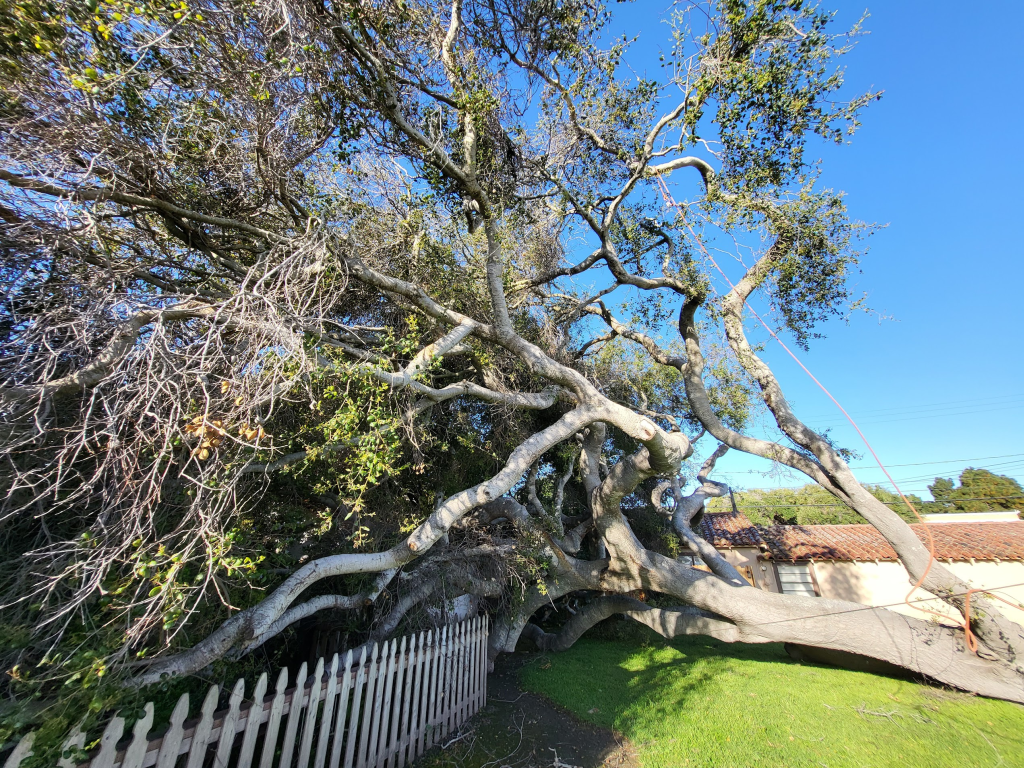
What to Look for After a Central Coast Wind Event
After a major winter storm or a “Pineapple Express” event hits the Central Coast, your trees have just finished a massive physical workout. Even if no large branches fell, the tree may have suffered “hidden” stress. Use this checklist once the wind dies down.
1. The “Hanger” Check
Look up into the canopy for branches that have snapped but are still caught in the upper limbs. These are literal “widow-makers” that can fall weeks later on a perfectly calm day.
2. Fine Cracks in the Crotch
Inspect the unions where large limbs attach to the trunk. If you see fresh, light-colored wood peeking through a crack, the limb has shifted and is partially failed. This requires immediate attention before the next wind event.
3. The “New Lean”
Check your tree’s orientation against a fixed point, like your house or a fence. If the tree looks more tilted than it did last week, look at the soil on the opposite side of the lean. Freshly disturbed earth or “mounding” indicates the root plate has shifted.
4. Saturated Soil Safety
On the Central Coast, most storm failures aren’t from the wind snapping the wood, but from the wind pushing a tree out of “liquefied” soil. If your yard is underwater, stay away from large trees until the soil has had 48 hours to drain and firm up.
Footnotes: ¹ Council of Tree and Landscape Appraisers (CTLA). “Guide for Plant Appraisal.” ² Lilly, S.J. “Arborists’ Certification Study Guide.”
The ArborSolutions Diagnostic
Post-storm damage isn’t always fatal. Before you allow a removal crew to take down a landmark tree, get an unbiased structural assessment. We specialize in post-storm risk mitigation strategies that prioritize both safety and tree preservation.