
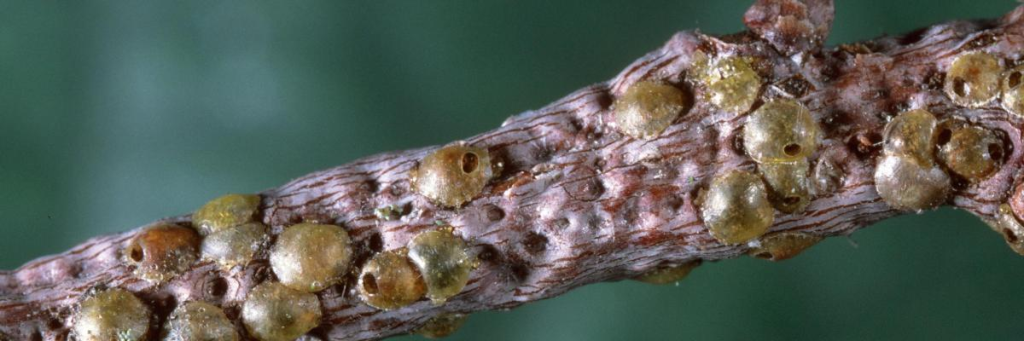
The Diagnostic: You might notice small, circular depressions or “pits” appearing on the bark of young twigs. This is often accompanied by “flagging”—a condition where small, isolated clusters of leaves at the ends of branches turn brown and die off.
The Science: Pit Scale (Asterolecanium) are tiny, stationary insects that settle on a twig, create a protective shell, and suck the sap. As they feed, the plant tissue actually grows around them, creating that cratered look. This effectively disrupts the tree’s “plumbing,” choking off the water supply to the leaves at the end of that specific branch.
The Red Flags:
- A distinct “bumpy” texture on twigs that are about the diameter of a pencil.
- The tree’s canopy looks noticeably “thin” or transparent on the outer edges.
The ArborSolutions Guide’s Action: Pit Scale is an “indicator” pest—it usually attacks trees that are already stressed. We rarely recommend heavy chemical sprays, as they kill the beneficial wasps that naturally control the scale population. Instead, we focus on deep-root watering and soil aeration to boost the tree’s natural immune system.
Reference: University of California Statewide IPM Program (UC IPM). “Pests in Landscapes and Gardens: Oak Pit Scale.”
🔍 Need a Professional 2nd Opinion?
The information above serves as a general guide, but every tree is a complex, individual living system. If you are seeing these red flags on your property, don’t leave the health and safety of your landscape to guesswork.
At ArborSolutions, we do not sell or perform tree removal or trimming services. We provide unbiased data and professional advice. We like to think of ourselves as the second opinion go-to before any major tree work decisions are made.
Ready to walk your property? Book a “Walking-Talking Tour” for a site-specific diagnostic and a clear, science-based path forward.